 |
 |
 |
 |
 |
 |
 |
SPA Historiografía |
contents
Introduction | Narrative | Transnational history | Translation histories | Translation historiography: The aims of the exercise | Research potential

The word history has a double meaning. It refers both to the past and to knowledge about the past. Historiography means the writing of history, and since this writing requires a degree of knowledge of the object, it encompasses the acquisition of that knowledge.
Historiography has a long tradition. In the West it is usually traced back to the Greek historians Herodotus and Thucydides, in China the conventional starting point is with the dynastic annals and biographies of Sima Qian (c.145-c.86 BCE). In what follows, I will restrict myself to recent developments in the West. Whereas a large part of medieval and Early Modern history in Europe aimed at drawing on the historical record to find examples of good or bad moral behaviour, modern historiography was put on a professional and scientific footing by the nineteenth-century German historian Leopold von Ranke. He famously described the historian’s task as that of describing the past as it ‘actually’ or ‘really’ (eigentlich) had been (Von Ranke 1824: vi). To carry out this task, Von Ranke declared, historiography had to take three steps: research on the primary sources, the critical interpretation of the sources, and weaving these interpretations into a narrative (Lambert 2020: 46). To a large extent, this is how modern historiographers still operate, with this difference that today a vast body of research has been accumulated to guide the practitioner. Modern historians formulate research questions, engage with the sources and write up their claims and findings in the context of, and with one eye constantly on, existing knowledge as laid down in research publications.
In practice, historiography is split into specialisms according to subject-matter (such as political or economic history, the history of table manners or of ideas), divisions of time and space (shorter or longer time spans, local or global perspectives) or a combination of these.
Because history typically comprises diachronic sequences of events, actions and their consequences, most historiography takes the form of narrative. True, a historical account may focus on a description of a synchronic slice of the past, but even cross-sections of this kind remain aware that the apparent stability being described is no more than a temporary respite in a sea of flux. History is a process of change. Narrative may therefore be thought of as a basic component of the historian’s craft. Historians tell stories about what happened in the past. They also describe, analyse, interpret and assign meaning to aspects of the past, but as part of an overarching narrative. Narrative tends to constitute the backbone of historical accounts (Harding 2021).
In the final quarter of the twentieth century, narrative became the focus of renewed attention from historians keen to think through the relation between narrative and the historical truth which the narrative purports to represent. The exercise became known as the ‘linguistic turn’, a term applied to many areas of the humanities but first used with reference to historical study in 1980 (Passmore 2020: 135). The reconsideration of narrative by historians responded to the success of the mid-century French Annales school, which had favoured structural and quantitative studies of large collectives over long periods of time. Both microhistory (see below) and the return to narrative went in the opposite direction, championing individual cases that featured events and active participants rather than structures and statistics.
Several ideas came together in the reconsideration of historical narrative. As early as 1821 the German statesman, linguist and translator Wilhelm von Humboldt had argued that historians should, as a matter of course, respect the archival record but that they also needed to supplement it by providing connections and a sense of direction that were not there in the record itself (Von Humboldt 1967). The French literary critic Roland Barthes showed in the 1960s that both historiographers and historical novelists often used techniques to present their stories as if they were factually true, obscuring the fictional (in the case of novelists) or interpretive (in the case of historians) nature of their accounts (Barthes 1967 [1981]). If the archive had to be both interpreted and supplemented and a narrative to be crafted by discursive means, how much fiction went into it?
The decisive contribution came from the American historian Hayden White. In a series of books and articles published from 1973 onwards, he stressed that a historical narrative is first and foremost a verbal artefact shot through with tropes and rhetorical figures that are absent or at least different from the archival record. The historian’s interpretation of the record requires some data to be downgraded and others to be foregrounded in the interest of the narrative under construction, while in other respects the historian makes inferences or provides explanations that are essentially guesswork superimposed on the documentary record. As White (1980: 15) put it, the historian’s narrative “charges events with significance” by assigning meaning and coherence to them. Narratives in turn may gain public acceptance by falling in with archetypal plot structures (such as overcoming obstacles to win a coveted prize; gradually revealing a basic truth about the world or human nature; restoring harmony following a conflict or disturbance). In all these ways, White maintained in a statement that became famous, historical narratives are “verbal fictions, the contents of which are as much invented as found” (White 1978: 82; his emphasis). Historians produce verbal fictions, but that does not mean they are not aiming at truthful accounts. The problem is that, to test this truthfulness, they cannot confront their accounts of the past with the past as it actually or really was, because that past is past, gone, inaccessible to us. All we have is the documentary record, which has to be respected but which also has to be analysed, interpreted, pieced together, supplemented and woven into the historiographer’s verbal fabric. We can compare narrative accounts of the past with each other, but we cannot compare narrative accounts of the past with the past.
If narrative is so central to the historian’s craft, what are its basic ingredients? As a rough guide, a narrative requires, first, a beginning and an end. In fictional stories this is not an issue because the fictional world has no existence outside the fiction, and so the beginning and conclusion of the story mark the start and closure of the fictional world. History, however, has no beginning (except, perhaps, in the Big Bang) and it ends only with the ever-shifting present moment. The slice of history treated in a historical account represents a conscious selection, made in function of the story the historian wants to tell.
Secondly, narratives need actors and events located in time and place. These make up the who? what? when? where? of narrative. Fictional narratives may confabulate actors, events, times and places as they wish, but historical narratives are constrained inasmuch as they have to take account of the available historical evidence. What counts as evidence is not always straightforward, since historians will select and marshal as evidence those elements from the historical record that fit the narrative they intend to create, and they will supplement gaps in the record with informed speculation. Within the narrative, the interaction between the various actors and events drives the story forward.
 |
|
| The French translator Claude de Seyssel offers his translation of Thucydides to the French King, 1514. [Source] |
Thirdly, the interaction between actors and events needs to be organised into a coherent and meaningful sequence. The arrangement of the story elements into a structured whole is called emplotment, and the plot is the resulting structured, meaningful sequence. Emplotment sees to it that the historical account displays either greater coherence or a different kind of coherence than the historical record. The record may already contain the narratives that the historical actors devised about themselves and their world, but the historian normally has the benefit of hindsight. Knowing the results and consequences of past actions in a way unavailable to the historical actors enables the historian to connect the dots and plot sequences while taking subsequent developments into account. This is one reason why the historian’s narrative will differ from the narratives embedded in the historical record. Another reason is that the historian has to interpret the sources in order to assign meaning to them in the context of the account to be written. In this sense emplotment provides a key to causation. Causation has been described as “one of the ‘glues’ that keep historiographic narratives together” (Tucker 2009: 98), but it remains a tricky concept. This is partly because, in a historical context, causes cannot easily be distinguished from conditions or reasons such as motivations, persuasions and pressures, and partly because causation tends to be multiple, complex and diffuse. We may be able to explain an event without being able to identify unambiguously what caused it. Narrative is particularly good at this. It can suggest connections without spelling them out, and its sequential presentation can invite the recipient to make inferences, causal or otherwise. In practice, what matters is how historians are seen to connect things and to justify their explanatory statements, that is, how persuasive we deem them to be in handling the evidence they marshal in support of their account of events (Tucker 2009: 108).
In addition to these basic ingredients, it is customary to distinguish three levels of narrative analysis. They highlight the fact that stories don’t tell themselves but are consciously orchestrated structures. There is first the level of the events as they must have happened in their logical and chronological order (also known as the fabula), then the level of the way and order in which the events are presented in an actual account (also known as the discourse), and thirdly the act of narrating itself (also known as narration). Historical accounts may manipulate the chronological order of events for dramatic effect or because they want to describe developments happening simultaneously in different places. Historians may foreground their role as narrators or, on the contrary, and more commonly, present historical actors and events while remaining discreetly in the background (and creating an impression of objectivity in the process). Drawing attention to the act of narrating has become important in other ways. What has become known as history from below (about which more below) tends to write the historian’s negotiation of the archive into the narrative itself, and is wont to ask who is telling which story on whose behalf – an ethical question. In a different context, writing about historiography that makes use of the plethora of digital sources and research tools available today led Fred Gibbs and Trevor Owen to argue that “we need history writing that explicates the research process as much as the research conclusions” (2013: 163).
Traditionally, historians and translation scholars did not have much in common. They were interested in different things. Translation scholars sought to understand the nature of translation or translation in the contemporary world. Historians, if they mentioned translations at all, repeated prevailing cliches about translation being either transparent or inferior.
Today, this is no longer the case. In the last thirty years or so, a significant convergence between history and translation studies has emerged, on two fronts. First, some forms of history have found resonance among students of translation. This applies to microhistory, memory studies, book history and, to a lesser extent, histoire croisée or entangled history. Secondly, the emergence of transnational history has meant that a number of historians stumbled on translations and translators as part of their research and now produce work in which translation is recognised as an intellectually complex and socially significant activity. It is true that, in the relation between history and translation studies, the influence goes primarily in one direction, from the former to the latter. History is by far the larger and more firmly established discipline. The asymmetry means that, while translation researchers have ready access to work done by historians, few historians even notice the work produced by translation scholars (Rundle & Rafael 2016: 30).
In what follows I will begin by discussing transnational history, if only because some of the other fields mentioned, like microhistory and memory studies, have themselves gone through the transnational turn. Transnational history emerged as an historiographical trend in the 1990s. It grew out of cultural transfer studies, which had already undermined the notion of homogenous national cultures by demonstrating that every national culture incorporated all manner of imports from beyond its borders and was therefore plural and hybrid (Berger 2020: 301). Cultural transfer studies were interested not just in the reception of imports but also in the means and agents of transmission, including such groups as migrants, exiles, tourists, diplomats, spies and translators (Berger 2020: 301). Other precursors were feminist history and postcolonial studies, which were transnational from the start.
The various forms of transnational history are united in their opposition to two things: eurocentrism and methodological nationalism. The rejection of eurocentrism does not mean that Europe’s historical role in world history is denied or diminished. It means, rather, that, since Europe should not be the yardstick against which to judge other parts of the world, knowledges produced elsewhere are valued in their own terms. Methodological nationalism, a hangover from the nineteenth century, is the idea that the nation state constitutes the natural unit of historical analysis. Transnational history wants to focus on mobility and migration, on contact zones, trajectories and interactions both within and beyond national and other borders. One consequence of this change of focus is that centre and periphery models (like polysystem theory) are set aside in favour of working with networks and interconnections (Paisly & Scully 2019: 4-8, 21).
 |
|
A world map from 1689 [Source] |
Dipesh Chakrabarty’s book Provincializing Europe (2000), with its telling title, put transnational history on the map. It wondered how notions like democracy, subjectivity or rationality, which had originated in Europe, had become universal. The universal, Chakrabarty suggested, was something unstable because it was always being adapted to local conditions, and these local inflections and mutations showed that even supposedly universal ideas contained elements that defied translation. This was historiography in which translation occupied a prominent place.
Viewed from a translation studies perspective, the key benefit of transnational history is that it helped historians discover translation. But transnational history is not just a branch of history. It affected many other forms and branches of history, which went through what might be called a transnational turn. Let me pick out some of these ways of doing history that experienced the transnational turn and proved particularly appealing to translation scholars.
Microhistory is a variant of what became known as history from below or people’s history, a form of historiography that sought to change the perspective from which historical accounts were written. It championed the experience of ordinary and downtrodden individuals and groups rather than that of social elites. Theodore Rosengarten’s All God’s Dangers (1974), for instance, based on taped interviews, presented the autobiography of an illiterate tenant farmer in Alabama who was the son of freed slaves and spent twelve years in a penitentiary. The Subaltern Studies Collective that emerged in India in the 1980s and found echoes in Latin America, was concerned with local history and disenfranchised communities (Guha 2001).
Microhistory became known primarily through Carlo Ginzburg’s book The Cheese and the Worms, first published in Italian in 1976 (Ginzburg 1980). It was based on transcripts of the trial of a 16th-century miller known as Menocchio, who appeared before the Inquisition due to his unorthodox views about the cosmos and its creation. Ginzburg was interested less in Menocchio’s theological musings than in the particulars of his day to day life. This approach became characteristic of microhistory. It painted vivid pictures of usually low-life individuals and groups whose existence had to be pieced together from archives not dedicated to them. The transnational turn affected microhistory inasmuch as it brought itinerant figures to the fore, including translators and interpreters. The approach appealed to students of translation because translators, too, were often characters of modest means (Adamo 2006). Rachel Lung, for instance, wrote about the ninth-century Korean interpreter Yu Sinōn, who travelled in Tang-dynasty China with the Japanese Buddhist monk Ennin; we know about Yu Sinōn only through Ennin’s diary (Lung 2015). In a similar vein Sylvie Kleinman (2012) documented the shadowy activities of Irish exiles who worked as interpreters and intelligencers in 1790s France. In both cases the negotiations with the archive were part of the story, and this is a feature of much microhistorical work.
The foundations of the modern history of ideas (also known as intellectual history, conceptual history or the history of concepts) were also laid in the 1970s, when two independent schools developed, one in Germany and the other in the Anglophone world, both concerned primarily with the history of political concepts. It soon became apparent that concepts and ideas migrate across borders, often by means of translation. In this way translation grew into a major component of intellectual history in its transnational guise. The German historian Jörn Leonhard, for example, traced the phrase idées liberales (‘liberal ideas’) as it travelled from France to Germany and Italy in the early nineteenth century. He noted that, in Germany, the term liberale Ideen, although calqued on the French, acquired a very different meaning because it was invoked to secure freedom of conscience, whereas in Italy idee liberali, another calque, meant something else again because there the Catholic Church associated the phrase with atheism and implacably opposed the idea (Leonhard 2008). Translation, in other words, even a rendering so close it approaches transcription, does not guarantee that meanings remain stable across languages. Each usage has to be studied in its own environment. Quentin Skinner, a major figure in Anglophone intellectual history, has made similar observations, pointing out that terms like el estado, der Staat, l’état or lo stato may well be encountered as translations of the state, but to assume on that basis that they all have the same meaning ‘presupposes what would have to be shown’ (Skinner 2010: 26). It is a statement of considerable import.
As the history of concepts has turned increasingly transnational and global, historians have made translation part of their investigations. The question they ask is not whether translators in the past made the right or wrong choice in rendering a given concept in a given way, but how translators perceived or invented correspondences between foreign concepts and their own world, and how these choices were subsequently accommodated or resisted. There are echoes here of Dipesh Chakrabarty’s observation (above) that supposedly universal concepts invariably show local inflections. As one survey of global intellectual history puts it, historians “examine the renderings that past actors have proposed and their consequences”, and this means that they are “less interested in the success of attempts at understanding than in the historical and often power-laden settings of enacted translations” (Moyn & Sartori 2013: 11-12). Statements like these, like those by Leonhard and Skinner, are of fundamental importance and might be taken to heart by anyone working on translation history. Translation does not bring about equivalence of meaning. What matters is the understanding and contextualisation of enacted translations.
Memory studies, too, began in a national context before turning transnational. This branch of history studies how the past is remembered, individually and collectively, in the present. The work of the French historian Pierre Nora is typical of the traditional approach. From the 1980s onwards Nora wrote at length about ‘sites of memory’ (lieux de mémoire), objects and locations where the national past was remembered, a national identity was fostered and the continued relevance of the past to the present was emphasised. But whereas for someone like Pierre Nora sites of memory were stable and durable, the more recent transnational memory studies seek to understand processes of remembering, different ideological uses of the past promoted by different interest groups, and the various media, including translation, by means of which the past is remembered and kept alive. For memory studies, translation is one mode of remediation among others.
A special place in memory studies is occupied by the Holocaust. The Nazi death camps in the Second World War were multilingual from the start, postwar testimonies by survivors were produced in a range of languages, and the international dissemination of these witness statements required multiple translations. But the translation of Holocaust testimonies posed ethical problems of a specific kind. The survivors had gone through experiences that others, including translators, could not imagine. Their words deserved the utmost respect; subsuming them under another language’s well-intentioned but inaccurate or inappropriate vocabulary might not do them justice. In a penetrating study of the translation of Holocaust testimonies, Peter Davies (2018) weighed these considerations against the shifts and dislocations that accompany all translating.
Book history has been transnational from the start. In its simplest form it is concerned with books as material objects: what does the size of a book, its binding, the quality of the paper it is printed on, its page layout, its use of such things as illustrations, headings and fonts, tell us about its intended readership? Even at this rudimentary level it becomes obvious that the object of study is not the material thing or commodity by itself but the human transactions that can be traced by following the trajectories of things-in-motion, as Arjun Appadurai put it in The Social Life of Things (1986: 5). Book historians realised early on that material culture is not really concerned with material objects but with “the entire complex of relationships between objects, their meaning and people” (Gerritsen & Riello 2013: 274).
 |
| The opening lines, in Hebrew and Latin, of Genesis in the Biblia Regia printed by Christopher Plantin in Antwerp, 1568-1572. Because Hebrew is written from right to left, the Latin transliteration is printed backwards. [Source] |
Very quickly book history extended its reach to comprise all aspects of the book trade, from the manufacture and dissemination of books to the economic conditions of their production and their use by actual readers, including quantitative studies. In a landmark essay first published in 1982, Robert Darnton devised an influential diagram showing the interaction between the individuals and institutions involved. Translators were not featured, but the diagram was eventually extended and adapted to accommodate translation (Bachleitner 2009; Belle & Hosington 2017). A recently updated version, explicitly transnational, is meant to equip the model for global publishing in the digital age, making room not just for the traditional authors, translators, printers and booksellers, but also for acquisition editors, right and grants managers and marketing staff (McMartin & Gentile 2020). Judy Wakabayashi (2019a) surveyed and compared a number of these models to gauge their applicability to a specific situation outside the European orbit, namely occupied Japan in the years immediately following the Second World War.
The basis for the convergence between book history and translation studies is twofold (Colombo 2019; Pickford 2021). There is, firstly, the textual trajectory of works and genres across space and time, their transmission and migration, and the changes they undergo along the way. A broadly conceived notion of translation, incorporating adaptations and reworkings of various kinds, has allowed mutations across media to be traced and mapped as well. The other cornerstone is materiality, the world of contracts, payments and working conditions, of which dictionaries or informants a translator had access to. But this is only the beginning. If our contemporary technologically saturated world has shown technology directly affecting professional translating, it seems reasonable to wonder about similar relations in the past, as Karin Littau (2016) has done: are there connections, for instance, between medieval scribal practices of copying and word-for-word translation at the time, or between oral culture and sense-for-sense translation?
Book history shares an interest in trajectories and materialities with other trends in historical and sociological research, such as technology studies, practice theory, actor-network theory and entangled history (or histoire croisée), all of which have also found echoes in historical translation studies. In the introduction to a book detailing the reception and translation of Frantz Fanon in a dozen languages, Kathryn Batchelor (2017) placed the various studies in the context of both histoire croisée and microhistory. Luo Wenyan (2020) applied actor-network theory to an historical translation project, namely Arthur Waley’s English rendering of the classic Chinese novel Journey to the West in the 1940s, making use of the extensive correspondence surrounding the project. Maeve Olohan (2021) used practice theory to understand the contemporary world of professional language service providers, but she had demonstrated earlier that approaches along these lines could also illuminate historical topics in scientific and technical translating (Olohan 2014, 2016).
As the paragraphs above show, various forms of history have found echoes in translation studies. The echoes used to be a long time coming. It took thirty years for microhistory to be noticed by translation scholars. The emergence of transnational history changed all that. Historians themselves discovered translation as a topic, and translation researchers have been quick to latch on to transnational ideas.
The interest in the history of translation has always been there. Traditionally translation historiography focused on ideas and discourses about translation rather than on translation practice. A book like Flora Ross Amos’s Early Theories of Translation (1920) may be regarded as representative. More recent decades saw various anthologies of discourses about translation. An early example is Edward Balcerzan’s 1977 collection of Polish texts but there have been many more, both national and international, the latter beginning with Hans Joachim Störig’s Das Problem des Übersetzens (1963) and culminating in Douglas Robinson’s Western Translation Theory (1997, 2nd edition 2002). The two volumes of Martha Cheung’s Anthology of Chinese Discourse on Translation (Cheung 2007; 2017), a collection of Chinese documents in English translation, has acquired the status of a model on account of its extensive annotations. It inspired the recent historical anthology of Arabic discourse in English translation (Shamma & Salama-Carr 2022).
Comprehensive historical surveys such as those by George Steiner (1975), Louis Kelly (1979) and Frederick Rener (1989) comprised both the practice and the theory of translation in Western Europe. Rather than offering sequential or evolutionary accounts, however, they tended to read the historical manifestations of translation as repeated variations on an immutable theme, depending on whether translation appeared to be conceived primarily as instrumental or as creative. Some surveys were of the nature of an inventory, as was the case with Henri van Hoof’s Histoire de la traduction en Occident (1991). Others had a wider geographical reach but remained patchworks. Between 1992 and 2002 Hans Vermeer compiled seven volumes covering translation history from ancient Mesopotamia to Renaissance Europe, but they were idiosyncratic compilations largely based on secondary sources and found little resonance in the discipline. By contrast, the collection put together by Jean Delisle and Judith Woodsworth in 1995, published simultaneously in both English and French, went through a second edition (2012), its broad range and relatively short anecdotal pieces making it more of an appetiser. Perhaps the most impressive achievement of this period was the three-volume encyclopedia Übersetzung Translation Traduction (Kittel, Frank, Greiner, et al. 2004-11), which was designed in the early 1990s and featured around 1,500 pages on aspects of translation history worldwide, even if its contributions remained isolated and uneven.
The opening decades of the present century saw a change of gear, as substantial and significantly more cogent surveys appeared, some of them originally conceived along national lines but most transnational in the event, even if this is not always made explicit in their presentation. The translation history of Spain, for instance (Lafarga & Pegenaute 2004), is based on a modern national territory but accounts for internal diversity with chapters on Catalan, Galician and Basque. The history of translation in the Low Countries (Schoenaers, Hermans, Leemans et al. 2021) deals mainly but not exclusively with translations into Dutch and covers an area that today comprises two countries, the Netherlands and Belgium. The three-volume Finnish history, published in 2007 and 2013, takes in the international Finnish diaspora (Paloposki 2021). Michaela Wolf (2012) described the rich variety of forms and functions of translation in the multi-ethnic and multilingual Habsburg state in the years between 1848 and 1918. The four volumes of the history of literary translation in English that have appeared to date (five are planned: France & Gillespie 2005-...) go up to 1900 and comprise not just the British Isles but also America where appropriate. By far the largest and most impressive achievement so far has been the four-volume history of translation into French (Chevrel & Masson 2012-19), which runs to well over 5,000 pages, ranges across disciplines and covers, as regards the modern period, Canada, Belgium and Switzerland as well as France.
While some of these histories may still be said to be transnational by accident rather than design, there have also been more determined attempts to write translation history across national and linguistic borders. They represent a new type of translation historiography in that they are based on explicitly formulated shared commonalities that hold a wide geographical space together culturally and historically. In this vein Judy Wakabayashi (2005) has traced the translation culture of Sinitic Asia, comprising China, Vietnam, Korea and Japan. The commonalities are threefold: the pervasive presence of Chinese culture, including the use of Classical Chinese as the dominant form of elite writing; frequent contact, both friendly and hostile; and the common experience of Eurocentric cultural colonialism in the nineteenth century. While these features provide a common umbrella, they leave ample room for regional variation. This is also the case with the even more ambitious history of translation in Central Europe (Chalvin, Muller, Talviste et al. 2019), an area comprising sixteen languages, plenty of cultural diversity and frequently shifting political borders. Yet the authors discern five commonalities relevant to translation: religious translations fostered written and then national languages; translations shaped secular literature in vernacular languages; Western Europe consistently provided cultural models; nation states formed in the eighteenth and nineteenth centuries; and the area suffered Soviet domination from 1945 to 1989.
In both these projects the commonalities need to be treated with considerable flexibility to do justice to both parallels and heterogeneity, to balance unity and nuance, complexity and local idiosyncrasy. Both histories also invited the question how far an approach along these lines can be stretched. The more diverse the area covered, the fewer and the more tenuous the commonalities. The temporal dimension plays its part, too. Certain commonalities are more in evidence at certain times than at others. As it happens, periodisation remains a tricky subject in all translation historiography (Wakabayashi 2019b). While, in theory, changes in the way translation is carried out or thought about might mark period divisions, in practice translation histories fall in with the prevailing broad divisions of cultural history, themselves the products of intellectual and material changes in the relevant societies.
![[heading title]](2.2-X.png "[heading title]") Translation historiography - The aims of the exercise
Translation historiography - The aims of the exercise
The publication dates of some of the studies mentioned in the previous section illustrate the popularity that translation history is currently enjoying. In fact, much more is going on. In his brief introduction to the Routledge Handbook of Translation History, Christopher Rundle (2021b: xviii-xx) summarises much of it: since 2004 at least eight journals have devoted special issues to translation history; three book series are currently appearing (two publishing exclusively in English, one in German, English, French and Italian); an annual translation history summer school was set up in Vienna in 2017; an online historical database of translator biographies was started in Sweden and inspired similar initiatives in Germany and the Netherlands; there is a specialised journal, Chronotopos, established in 2019; and a new association, the History and Translation Network, complete with online manifesto, held its inaugural conference in May 2022. The publication of the Routledge Handbook of Translation History itself is surely a sign of the times.
All this activity suggests a growing interest not only in producing histories of translation but also in methodological, conceptual and other questions relating to translation historiography (Lange & Monticelli 2022). Among the issues at stake are the objectives of researching translation history and the relation between history and translation studies as disciplines.
Reflection of this type began when, in 1992, Anthony Pym listed what he saw as the methodological shortcomings of translation historiography as it was then. He summed them up as: an accumulation of data not guided by clear research questions; the use of unfalsifiable methodological hypotheses, of anecdotal evidence and of indiscriminate periodisation (such as, say, ‘nineteenth-century translation’); a vision of translations as merely reflecting prevailing tastes rather than as potential active agents of change; the privileging of target cultures at the expense of transnational connections; and a failure to appreciate the interculturality of translators (Pym 1992: 233). While the last item in this list may be dismissed as special pleading (Pym championed ‘intercultures’ at the time), the remaining shortcomings were real enough.
Since the days of this criticism, much has happened. Pym himself brought out a book on the methodology of translation historiography (Pym 1998). Lieven D’hulst published a number of theoretical essays since 1990, some of them eventually collected in book form (D’hulst 2014). A collection like Charting the Future of Translation History (Bastin & Bandia 2006) devoted nearly half its contributions to questions of method. Several recent books (Vidal Claramonte 2018; Rizzi, Lang & Pym 2019; Richter 2020; Hermans 2022) address conceptual and methodological issues at length, some taking their cue directly from professional historians. In interventions that have attracted attention in translation studies circles, Christopher Rundle (2012; 2020; Rundle & Rafael 2016) has highlighted the problematical relation between historians and translation scholars.
 |
|
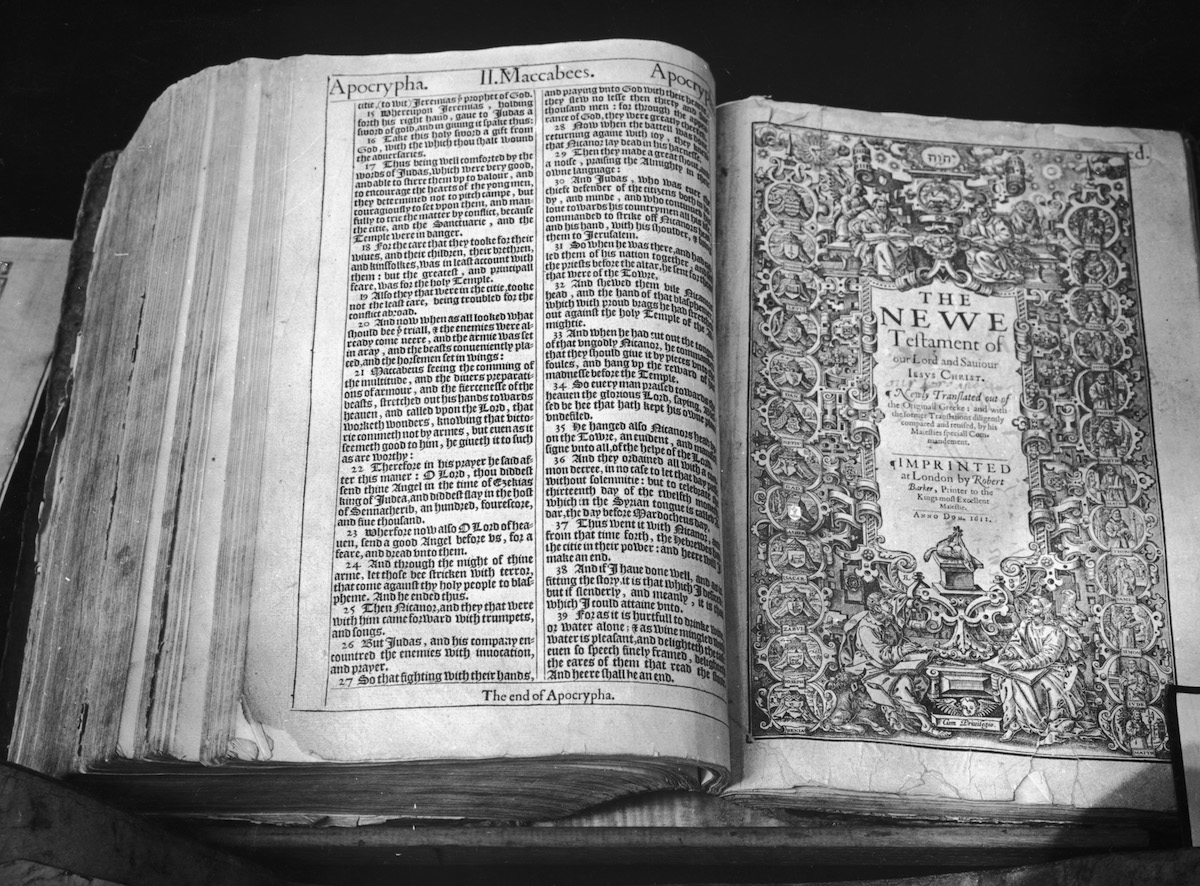
The King James Bible of 1611, a translation, is perhaps the most important book in the English language. [Source] |
The reasons why this relation is problematic are practical as well as conceptual. Not only is history, as mentioned earlier, the larger and more firmly established discipline, it constitutes a scholarly community with its own infrastructure in the form of communication circuits, points of reference and styles of argumentation. But the conceptual differences are more fundamental. Historians embrace all aspects of the past, whereas translation scholars champion a single dimension. Translation scholars tend to look for the general features and constants of translation, whereas historians focus on the uniqueness of historical events (Rundle 2020: 236).
This last opposition takes us to the heart of the matter. History and translation studies have different research objectives. The aims of translation historiography have been defined as gaining insight into (1) the nature of translation and translating, (2) the impact of historical contexts on the practice and conceptualisation of translation, (3) the historical impact of individual translations, and (4) the place and role of translation in certain historical contexts or constellations (St-Pierre 1993a: 9; Rundle 2020: 235). This set of aims is worth critical scrutiny.
The first aim involves improving our understanding of translation by studying its past manifestations. For most professional historians, this would probably not count as historical study at all, because the object of the study is not a historical object. Historians are not after understanding, say, the nature of revolution by studying past instances such as the French, the American, the Iranian and/or the Chinese Revolutions. They want to study those various revolutions as unique events. They may draw parallels and make comparisons, but the aim would be to appreciate the individuality of each event.
The second aim, that of understanding translation as embedded in its time and place, involves studying translation as conditioned by the social, intellectual, institutional and other factors around it or, alternatively, studying translations as interacting with the values dominant in certain spheres at certain times (St-Pierre 1993b: 63-70). The historical relevance of this type of study is not in doubt. Still, a historian might wonder what, among the numerous other activities that are conditioned by their context, makes translation special. Put differently: since there are many other ways to gauge the importance of prevailing values and conditions on social and intellectual life, it is up to the translation historian to demonstrate in what respect translation constitutes a uniquely significant index.
The third aim bears on the afterlives of translations, and the historical difference individual translations have made, in short on translations making history. This leads to investigations of the way translations act on their immediate or, if they have a slower fuse, on later contexts. The challenge here is to understand not just how translations affect the historical present which they address, but also to assess how these translations relate to other factors shaping that present.
The fourth and final aim inverts this perspective. Here the goal is to understand a slice of history and to use translation as a lens to gauge that historical constellation (Rundle 2011: 33; 2020: 235). The goal may be reached either by contextualising translation to the point where the focus has shifted from the translation to the context, or by envisaging a historical constellation and figuring out the place and role of translation in it. As the transnational turn has shown historians, virtually any slice of history harbours a translingual dimension. This is also the most obvious meeting place for translation researchers equipped with an awareness of history and historians with an eye for languages and translation.

#/media/Archivo:Domenico_Ghirlandaio_-_St_Jerome_in_his_study.jpg)

The study of translation in its historical context constitutes the obvious research area of translation historiography. The scale can vary from micro to global, that is, from the level of specific projects undertaken by individual translators or interpreters to various forms and genres of translating and interpreting at local, institutional, regional, national or transnational level. Naturally, the larger the research project, the more collaboration and coordination with other researchers will be needed. While some projects may require research in archives, a vast amount of material printed before about 1900 has been digitised, including numerous now forgotten translations. There are also electronic databases, some geared specifically to translation but most, including the most powerful (such as WorldCat), more general in nature. The key to all translation historiography is contextualisation: the aim is to understand translations, translating and translators in their historical context. Because translation is invariably part of something much larger than translation, it cannot be studied on its own.