 |
 |
 |
 |
 |
 |
 |
SPA Japón |
contents
Introduction | Sidestepping translation (8th to 19th centuries) | The first professionals (16th to 19th centuries) | Alternatives to kundoku | Arrival of European languages (1549-1639) | Dutch tsūji (17th to 19th centuries) | Translations by scholars (18th to 19th centuries) | The first Meiji phase: Utilitarianism (1868-1878) | Introduction of literature (1877-1886) | Toward fidelity (1885-…) | Broadening of approaches (1890s-…) | Plays | Leftist translations and foreignization (early 20th century) | Early Shōwa (1926-45) | Early Occupation years (1945-48) | GHQ translation program (1948-51) | Normalization (1950s) | Commercialization and self-cultivation (1960s-70s) | Celebrity translators (1980s-…) | New millennium | Research potential

Japan has often been described as a "translation culture," given the volume and impact of texts introduced from other languages over the centuries. Yet until about 150 years ago the usual mode of introducing foreign texts differed in several respects from what is commonly thought of as translation. The adoption of Chinese characters for use with Japanese, which belongs to a different family from Chinese, was followed a millennium later by the challenges of grappling with languages that do not use Chinese characters. Japan's geographical status as an island nation hampered contacts with other cultures, and in early modern times this was compounded by a period of "national isolation" in which the Chinese, Koreans, and Dutch were the only foreigners allowed in Japan. This entry sketches key developments in translational practices in Japan from ancient times to the present day. The approach is broadly chronological but also thematically based, reflecting the characteristics of different phases of translation history in Japan.
 |
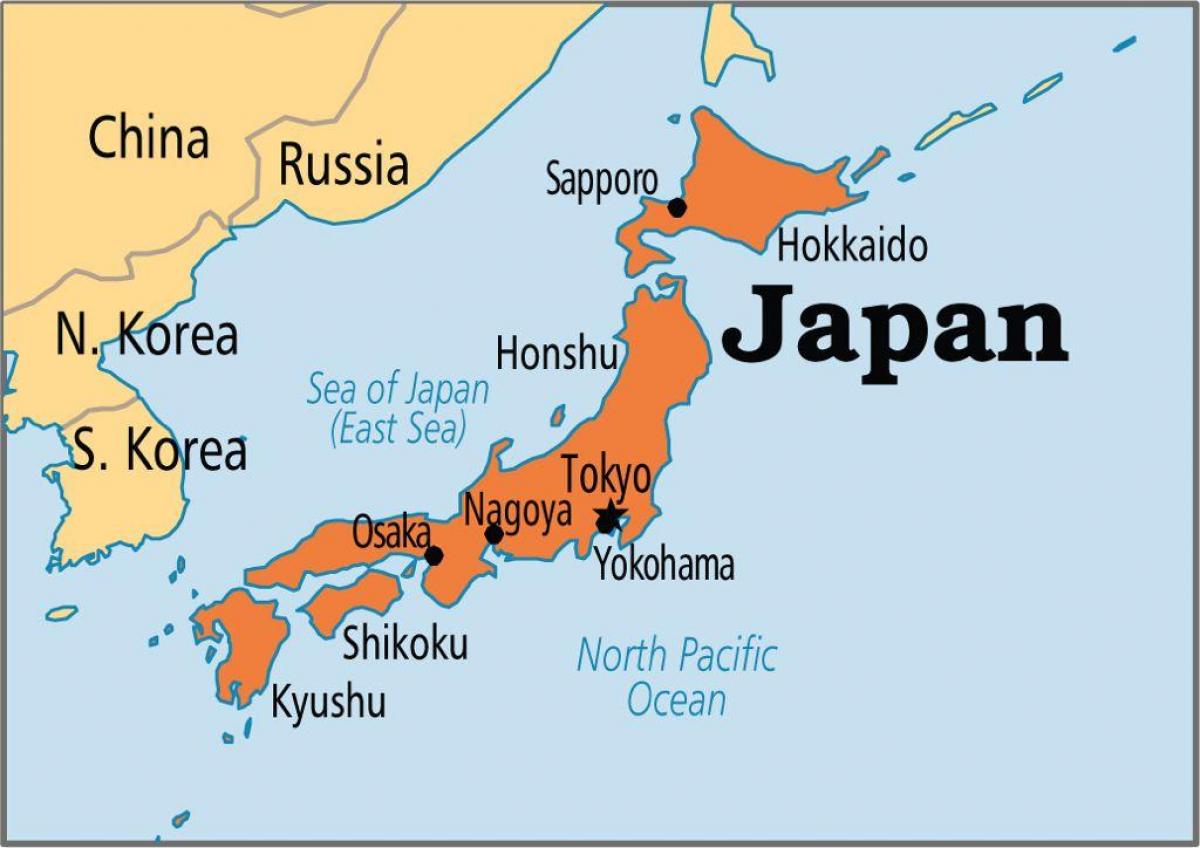
| Map of Japan [Source] |
![[heading title]](2.2-X.png "[heading title]") Sidestepping translation (8th to 19th centuries)
Sidestepping translation (8th to 19th centuries)
Japanese contacts with other languages predominantly revolved around relations with Chinese until the sixteenth century. For over a millennium the mainstream approach to Chinese texts was not translation, but kanbun kundoku (translingual reading of Chinese using Japanese glosses; hereinafter kundoku).
Lacking a writing system, the Japanese adopted Chinese characters (kanji) in the fifth century, although the languages are unrelated. Kanji represent sound and meaning, which can be associated with sounds from other languages. The Japanese read kanji in an approximation of Chinese pronunciation (Sino-Japanese) and also assigned them the pronunciation of the Japanese word of similar meaning.
Kundoku originated around the eighth century. The basic process involves a glossator (1) annotating Sinitic (Classical Chinese) texts with sequential markers to guide readers through the syntax, (2) adding Japanese grammatical particles and inflections, and (3) giving Chinese words interlinear Sino-Japanese or Japanese glosses. There is no physically separate target text, and kundoku is often performed only in the mind. Habitual use of a Japanese gloss to read a kanji established a relationship that could be reversed to write the Japanese word.
In the ninth century two phonetic syllabaries collectively known as kana were developed. Katakana were mainly used interlinearly on Sinitic texts, while hiragana were used for informal or private writing. Kanji remained the dominant form of writing.
| 日本 | 二ホン | にほん |
| Nihon (meaning “Japan,” written in kanji) | Nihon (in katakana) | Nihon (in hiragana) |
In early Heian times, there was a preference for relatively flexible kundoku using contextually determined glosses. Around the mid-Heian period, different glossing practices became standard within designated families of bureaucrat-scholars and were passed from teacher to student. Different Buddhist sects also taught differing forms. Standardization within these approaches facilitated comprehension but shifted the focus away from translation.
From around the twelfth century some kundoku renditions were written out as a separate text in Japanese word order. This made Sinitic works more accessible and is closer to conventional translation, but it still consisted of “kundoku language”.
Different orthographic modes (varying depending on the extent of Sinicization/Japaneseness) interacted with conventionalized styles (from stiff kundoku style to mixed Sino-Japanese then “soft” Japanese style, with many subvariants from the classical to the vernacular). The choice of orthography and style depended on genre, context, and readership.
The first professionals (16th to 19th centuries)
Trade in Nagasaki, Japan’s largest port, led to a need for interpreters and translators, who were collectively called tsūji. Chinese tsūji were immigrants from China or their descendants, and in 1604 this was established as an official position. In line with national seclusion orders issued in the 1630s to ensure social stability and exclude foreign influences except for China and Korea, Nagasaki was designated the sole port for overseas trade in 1635.
This profession was in principle hereditary. There were over 40 families of official tsūji and about 20 families of privately employed tsūji. In 1672 the core structure settled on four senior and five junior official tsūji at one time, as well as trainees. Official tsūji’s duties included translating and interpreting, religious surveillance, helping Chinese and settling disputes among them, supervising commercial transactions, and gathering intelligence. The system involved training, rudimentary quality control, reasonable remuneration (depending on rank), and an embryonic code of ethics. Languages in far less demand included Siamese, Tonkinese, Luzonese, Mughal and the language of Takasago.
Koreans’ use of Sinitic as their primary written language until the late nineteenth century meant Japanese could understand Korean texts without translation, but spoken Korean was required in trade. From the fifteenth century, bilateral relations were mediated by Tsushima domain, which was close to the Korean Peninsula and the only domain allowed to trade with Korea from 1639. Sixty families with special trading privileges with Korea (the Sixty) interpreted as necessary. During Korean diplomatic missions to Edo (present-day Tokyo), Tsushima mobilized as many as 50 interpreters. In 1693 tsūji were stationed at the waegwan (a Japanese trading post on the Korean Peninsula) for the first time. Tsūji’s roles extended beyond linguistic mediation, as they sometimes took the initiative in business and diplomatic exchanges and acted as information conduits for Japan. To boost tsūji numbers, the domain established a Korean training institution in 1727, restricted to descendants of the Sixty until 1750, and thereafter opened more widely. Students with aptitude could continue studying at the waegwan. After the Meiji Restoration of 1868, relations with Korea were taken out of Tsushima’s hands.
A less institutionalized system surrounded tsūji in Ezo, which was inhabited by the Ainu people, who had their own languages. Trade grew in the wake of seventeenth-century Japanese efforts to colonize the northern frontier. Tsūji were employed on a commercial rather than official basis. After the subcontracted trade system was established in the late eighteenth century, they were expected to supervise, monitor and look after the Ainu. The late eighteenth-century arrival of Russians seeking trade necessitated mediation between Russian and the Ainu and Japanese languages, with Ainu mainly serving in this role.
Japanese encounters with Westerners increased in the nineteenth century, highlighting the need to study other languages. With the opening of the country in 1854, there was increased need for translation and interpreting, but these functions soon moved from Nagasaki to Edo and the tsūji system came to an end in 1867.
Interest in Neo-Confucianism grew after the shogunate encouraged it as the official ideology in 1691. Some scholars, however, became critical of Neo-Confucian commentaries on the Chinese classics, leading to moves to understand them directly. Ogyū Sorai believed that reading without commentaries, annotations or sequential markers allowed independent interpretation. He objected to the conventional glosses, since the established associations were “archaic and obscured nuance” (Clements 2015: 122) and concealed the fact that the product was a flawed translation. Sorai presented three alternatives to kundoku, with the third constituting his ultimate objective, although the first is most relevant here.
- Translating into vernacular Japanese—as a provisional measure.
- Studying modern vernacular Chinese, to draw closer to Chinese texts. Again, this was a provisional measure.
- Studying ancient texts.
Sorai argued that if kundoku could not be abandoned, at least some glosses should be in context-based vernacular Japanese.
Despite the lack of widespread support, Sorai’s views marked a turning point. Kundoku methods became simplified, with greater use of Sinitic pronunciations, fewer supplemented words and phrases, and the reading of all kanji. Kundoku was brought closer to Sinitic usage, making it even less natural as Japanese.
In the Meiji period attempts were made to extend kundoku to European languages, but these were largely unsuccessful, because it was not possible to draw on the semantic properties of kanji. Instead, growing familiarity with European languages from the 1890s meant a fundamental shift toward translation, although kundoku remained in use with Sinitic texts. Early twentieth-century education ministry guidelines standardized Edo-period methods, and kundoku is still taught at high schools today.
The 1880s saw the emergence of kundoku style, a sinified style influenced by but distinct from kundoku practice. It was associated with literal translations of European texts and was also used in original writing. Its practicality (e.g., the conciseness of kanji compounds) lay behind its popularity, while the difficulty of understanding it parodoxically added to its prestige.
Arrival of European languages (1549-1639)
Portuguese traders arrived in 1543, followed by Jesuit missionaries and other Europeans. Unlike other phases of Japanese translation history, most key texts translated during the “Christian Century” (1549–1639) were religious texts, and Europeans played an important role. Reflecting an acculturation policy, the missionaries initially used Buddhist terms to introduce Christian concepts, but that led to misunderstanding. They then decided to retain key religious terms in Latin or Portuguese, but this highlighted Christianity’s foreignness, and assimilating these terms took time.
In 1590 a Christian legation to Europe brought back a printing press and Latin type. Types for kana and kanji were soon developed, enabling the printing of Latin, Portuguese and Japanese works. Although over 100 titles were printed in less than two decades, only 42 are extant.
“Christian literature” refers to works written or translated by Catholics. The largest category of translations consisted of religious works. By 1613 the Bible was being translated, but that text is lost, making extracts in Supiritsuaru shugyō (1607) valuable. Partial translations of the Gospels, selected passages from prayers and catechisms, and portions of the Old Testament were used in missionary work and sermons.
The second category consisted of a handful of secular works, including the first translated work of European literature, Aesop’s Fables. In 1593 a romanized translation, Esopo no Fabulas, was printed. Its language was the most vernacular of any “Christian literature” so that the tales could be easily understood by the missionaries studying Japanese and by the public. The purpose was didactic, rather than introducing European literature. The third category consisted of dictionaries and grammars.
Concerned over potential colonization and Catholicism’s influence, the authorities issued anti-Christian pronouncements from 1587. In 1614 the shogun banned Christianity and limited foreign trade to Hirado and Nagasaki. The press was sent to Macao, and the authorities destroyed most Christian publications. In 1638 foreigners were expelled. Only the Dutch were allowed to continue trading, because they had no interest in proselytizing and were perceived as an information source and counterbalance to the threat presented by Portuguese and Spaniards.
Certain features broadly distinguish extant Christian Century translations: a focus on communicating the message; emphasis on readability; preference for transcription of key concepts; the fact that nearly all were in classical Japanese, with abundant use of kana and a fluent style unifying the elegant and vernacular. The translators showed increasing willingness to adapt, add, omit, explain and change the originals. Collaboration was another feature: “the European missionaries would transmit the respective contents to their collaborators, who would later provide an oral translation, whose phonetic transcription was recorded by the missionaries in the Roman alphabet” (Loureiro 2004: 44). This helps explain the lack of individualistic features—only three translations record the translator’s name.
The few works translated had such a circumscribed impact that they did not represent a threat to kundoku. With the end of the Christian Century, the Jesuits’ communicative approach was abandoned. “Christian literature” had no influence on mainstream literature, and translations in this period did not bring about fundamental changes in society.
Dutch tsūji (17th to 19th centuries)
In the early seventeenth century the Dutch and English established trading posts in Hirado, while the Spanish and Portuguese had trading posts in Nagasaki. This required translators and interpreters, who were employed privately.
In 1616 foreign ships (except for Chinese and Korean ones) were banned from entering ports other than Hirado and Nagasaki. In 1641 the Dutch were ordered to move to Dejima island in Nagasaki harbor. Although far from the politico-cultural center, Nagasaki became the center of trade, information, and translation for much of the Edo period.
 |
| An early nineteenth-century drawing of the Dutch trading post on Dejima [Source] |
Dutch tsūji were now employed as local officials. Thirty-six families were active as Dutch tsūji. By about 1656 the distinction between senior and junior tsūji arose, and along with trainee tsūji they played the leading role, although two dozen lower ranks were also established by 1754. A typical configuration was four senior, four junior, and eleven trainee tsūji, plus assistants. Their work included translating crew lists and cargo inventories, inspecting Dutch ships, and handling the money in trade transactions. Tsūji worked as translators, interpreters, customs officials, doctors (after learning medical techniques from Dejima physicians), teachers, and informants. A separate (and the largest) group consisted of privately employed tsūji, who were of lower status and mainly did interpreting in commercial settings.
Tsūji were among the very few with access to the Dutch and their knowledge, which placed them in an influential position despite their relatively modest status. The more scholarly-minded translated substantial works in particular disciplines, notably medicine (but no literary works). The shogunate was selective in what could be translated and had a policy of censoring translations.
By the end of the eighteenth century a reasonable system of training was in place. A code of translator ethics also emerged, although Dutch records contain frequent criticism of individual tsūji’s ethics. In the 1829 Siebold incident, some tsūji were punished as spies, leading to heightened restrictions on translation of Western books.
Faced with imported objects and concepts, tsūji often used Sino-Japanese expressions or calqued the elements of Dutch words. They also used transcription into kanji or, less commonly, katakana.
In 1808 the shogunate founded a bureau in Edo for translating Western books. Because scholars there were not yet capable of this, at first tsūji were sent from Nagasaki, representing the establishment of full-time official positions for translators in the capital and marking the start of official patronage. The bureau translated diplomatic documents, world maps, scientific works, news articles, and technical manuals. The shogunate sponsored translation projects, with the goal of both promoting and controlling science.
Incidents involving Russia led the shogunate to order 14 Dutch tsūji to study Russian in 1809. A few were also ordered to learn French and English because of growing awareness of Western nations as a threat.
In the early 1850s, pressure to end Japan’s seclusion, as well as awareness of its inferior technical and scientific knowledge, thrust translations into a more central position. This led to the 1857 founding of Bansho Shirabesho, which became the main government-sponsored institution of Western Learning and centralized the translation of Western works. Undergoing various organizational and name changes over the years, it collected existing translations, trained translators and interpreters, and published translations. By 1860 the focus of language needs had shifted to English, and translators trained in Dutch disappeared by about 1897.
Translations by scholars (18th to 19th centuries)
Scholars turned their attention to Dutch works after 1740, when faced with evidence of the superiority of Western Learning over certain aspects of Chinese knowledge. At first, they learned from tsūji and from Dutch visiting Edo. Their need was comprehension—at most, to exchange information with other scholars, rather than disseminating it to the public—so there was little compulsion to adopt an accessible approach. The output was in Sinitic or its written-out form. Scholars decoded texts in a kundoku-like manner, writing equivalents above or below each Dutch word and rearranging the order in accordance with sequential markers. Feasible because word order is similar in Dutch and Chinese, this was a useful interim measure.
Several scholars set up academies where they taught the Dutch language and Western Learning. Late-Edo Western Learning circles were represented in Osaka by Ogata Kōan and in Edo by Sugita Seikei, whose translation approaches differed. Influenced by his studies in Nagasaki and in contrast to most scholars, Kōan’s approach consisted of grasping the sense and translating freely without constantly referring to the original. In 1838 he opened a private school in Osaka that became Japan’s largest school of Western Learning, so its teaching methods had considerable impact. Sugita Seikei represented the literal approach, and although his translations were refined they could not be understood in a single reading.
The texts translated were of a predominantly utilitarian nature, focusing on natural sciences, and except for a few historical and biographical works it was not until the 1860s that the humanities were introduced. Readers expected renditions from Dutch to be stiff and contrived, and some Dutch-influenced structures came into wider use.
Although scholars often studied under tsūji, the fact that they outnumbered tsūji and were of the elite meant that eventually their predominantly literal norm triumphed over tsūji’s communicative approach. Nevertheless, these groups were interdependent and collaborated, and there were exceptions to the norms.
The first Meiji phase: Utilitarianism (1868-1878)
The Meiji Restoration introduced fundamental social, political, and economic changes that paved the way for a modern nation, and translations were vital to this. In the first Meiji decade the focus remained on nonfiction works of immediate benefit, now including fields such as philosophy as a catalyst for reforming Japanese thought and institutions. Various ministries produced translations about law, politics, and economics. In the 1870s, however, nearly half the works on new technologies were published by the commercial sector, reaching more readers. Terminology was more or less standardized by the early 1880s, with Sino-Japanese words constituting the core. Most translations were in sinicized diction.
The educator Fukuzawa Yukichi was instrumental in introducing Western ideas, institutions, and civilization. His principle of using Japanese equivalents for English terms went against the prevailing norm, and he used different equivalents in different contexts.
Nakamura Masanao’s Saigoku risshihen (1870–71) was a translation of Samuel Smiles’ Self-Help, the most popular Western work in Meiji Japan. It preserved orthodox writing styles but breathed new life into them. Nakamura avoided difficult or classical words, and the translation has a pleasant rhythm. Translators influenced by Nakamura expressed Western ideas through the strength and crispness of Sino-Japanese words and Sinitic style, creating a fresh new style.
From 1874 seven missionaries and three Japanese assistants worked to produce a Protestant translation of the New Testament, referring to English commentaries and Chinese translations. Published in 1880, this combined vernacular idiomaticity with elegant pseudo-classical language. The Old Testament was completed in 1887. The Meiji Bible was influential not only as a religious work but also as a literary text and a work affecting Japanese language and thought. Nevertheless, linguistic changes and advances in biblical scholarship led a committee of four missionaries and four Japanese to produce a new translation of the New Testament between 1910 and 1917.
The literary world was at a low ebb at the time of the Restoration, when there was little leeway for reading or translating foreign novels. Except for Sinitic poetry, literature was viewed as a means of encouraging proper morals. When translations of literature did get under way, the motivation was as a means of understanding Western civilization, rather than entertainment. Only when Japanese began to realize the regard in which literature was held overseas did this begin to change.
Introduction of literature (1877-1886)
From 1877 to 1886 was an ‘age of translation’ when most major works of English literature were translated. In general, they grandly amplified on and omitted parts of the originals, verging on adaptations and prioritizing entertainment rather than literary qualities.
This phase opened with the best-selling publication of Karyū shunwa, a drastically abridged and loose rendering of Edward Bulwer-Lytton’s Ernest Maltravers and its sequel Alice. It represented the first translation of an English novel, as distinct from fables and adventure stories. The translation exemplified the journalistic written-out form of Sinitic, matching the innovative mood of the times.
 |
| Karyū shunwa [Source] |
French literature began to be translated around 1878 with the introduction of Jules Verne’s novels. The first from a French original was Kawashima Chūnosuke’s translation of Le tour du monde en quatre-vingt jours. This is regarded as the first faithful translation of literature—a far cry from Karyū shunwa, published a few months earlier. Kawashima’s domesticating translation was in kundoku style, a trend that continued. Verne became the most-translated novelist at the time.
Translations of European political novels partly reflected the spread of democratic rights ideology. They were at their peak in the decade from 1880, although the boom was short-lived. The Freedom and People’s Rights Movement triggered censorship aimed at disruptive elements, and the government instituted a crackdown on books that favored democracy, so the focus on ‘civilization and enlightenment’ ended around 1884.
Translators gradually became aware that focusing solely on content was insufficient. Around 1882 a purely aesthetic motivation for translating poetry emerged, although the general approach to literature still involved free or selective translation of the plot. From about 1882 German became an important source language, and the first rendition of Russian literature was in 1883. From the late 1880s, texts from other countries began to appear, usually via English or French. From 1887 there were calls for faithful translation in an attempt to emulate the West and its modernity as closely as possible.
Classical Japanese styles were considered “too Japanese” for European literature, but Sinitic also proved inadequate because of its stiffness, mannerisms, and limited lexicon. Since modernization and democracy required equality in accessing texts, reform was necessary to make prose styles more consistent with spoken language and easier to understand. From about 1887, the modern vernacular was used by translators of practical works, although literati were slower to adopt it.
Methods to create equivalents included redefining existing (Sino-)Japanese words, recycling words with a similar meaning from the Chinese classics or Sinitic translations of Buddhist sutras, borrowing from English–Chinese dictionaries and Chinese translations of Western works, modifying the form of words used in the past, combining kanji, coining original equivalents for specialized terms, paraphrase, and phonetic transcription. The emphasis on translation rather than transcription meant Western concepts could generally be understood, despite the discrepancy from spoken Japanese (resulting in a ‘language of translation’) and occasional semantic shifts. The words’ aura of novelty took precedence, and it was only later that the meaning became clear. This valorization of indeterminacy recurs throughout Japanese translation history.
Although Japan had a long poetic tradition, modern poetry was born largely under the influence of translated Western poetry. ‘New-style’ poetry’s lack of formal restrictions and ability to draw on more diverse imagery and styles made it better able to express modern ideas.
Around 1885 new moves arose seeking to understand the West without relying on extreme domestication. Keishidan, a translation of Lytton’s Kenelm Chillingly, was known for its close and meticulous (shūmitsu) approach. Using sinicized diction, it sought an exact rendering that included the rhythm, tone, and manner. Many translators began to make efforts to reproduce the style, and literal translations formed the mainstream, alongside a shift to more vernacular language. The journalist Morita Shiken, who produced many outstanding translations through to the late 1890s, perfected the shūmitsu approach. Seeking to move away from Sinitic influences, he blended Chinese rhetoric with the literal style of translating English works.
Against the backdrop of political activism in the 1880s, Futabatei Shimei translated Russian revolutionary writings, merging Russian influences and the Japanese vernacular to create a new literary language. He elevated translation to an art while implementing new standards of accuracy. There was increasingly discriminating text selection and a shift toward modern literature rather than the classics. Futabatei’s Aibiki (1888), the first full-fledged vernacular translation, was a translation of Svidanie from Turgenev’s Zapiski okhotnika. It is relatively free, although Futabatei emphasized the original form even at the expense of naturalness. He fused the exactness of the shūmitsu approach with the spirit of the movement to align speech and writing, which took off in the mid-1880s. Aibiki’s novel style—including the attraction of its occasional awkwardness—influenced literary circles, particularly Naturalist writers. Nevertheless, Futabatei’s efforts to reproduce aspects such as tense and punctuation met with criticism, and he came to realize that different writers require different styles. Despite Futabatei’s critics, the modern language integrated Japanese, Chinese, and Western elements along the lines of Futabatei’s style.
 |
| Wakamatsu Shizuko (1864-96) [Source] |
Translation remained a predominantly male occupation. The first woman to produce translations of significance was Wakamatsu Shizuko. Her text selection reinforced traditional family values, stemming from her background as a Christian educator and the fact that her readership included children. Shizuko’s most famous translation, a rendition of Little Lord Fauntleroy serialized between August 1890 and January 1892, was important in developing children’s literature. She was more interested in the contents than fidelity to the wording, but her clear and natural style boosted interest in the vernacular. Although the work of Shizuko and the Russian translator Senuma Kayō was not overtly feminist, in the 1910s members of the Bluestocking Society and other women used translation “to resist or subvert attempts to control female sexual and gender expression” (Welker 2010: 160).
It was only at the end of the nineteenth century that texts oriented toward children appeared, with the original vehicle being translations, adaptations, and retellings of European works. Children’s works were initially viewed as a means for adults to learn about Western culture. Educating children was a secondary aim, and entertaining them was not essential. Until about 1878 the focus was on nonfiction. American and particularly German influences were important, and the engagement with Western ideas helped transform conceptions of childhood. By the late 1880s—before publication of the first original work of children’s literature in 1891—this new category of readers was specifically mentioned as an audience for translations. It required adjustments such as using more hiragana, adding glosses, omitting or altering cultural references, and abridging the text.
Broadening of approaches (1890s-...)
Uchida Roan was particularly known for introducing Tolstoy and Dostoyevsky, albeit via English. His Crime and Punishment (published in two parts in November 1892 and February 1893) made skillful use of the still-unfamiliar vernacular style. His approach—free translation unconstrained by the original form—was groundbreaking.
Until the early 1890s, translated literature was of greater importance than original writing. Victory in the Sino-Japanese War meant Japan adopted a slightly more independent attitude, but ongoing claims that translation’s aim was to develop Japanese literature were a feature and limitation of the discourse in the 1890s (Tomita 1965: 170). Despite the centrality of translations, 1902 was the only year when translations outnumbered non-translated works (Zwicker 2006: 149).
Between 1891 and 1898, academic journals generally supported free translation, with most contributors stressing the need to convey the tone, force and spirit. As time passed, both the free and literal translation views were increasingly emphasized, indicating heightened expectations of translations.
In 1894 Nagai Kafū’s best-selling translation of Zola’s Nana spurred the Naturalist movement. The literary periodical Taiyō played an important role in introducing Naturalist writers. It carried translations in a range of styles and approaches, reflecting the translation scene at the time.
From around 1897 translated literature flowered in literati’s hands. Translations of classical works were replaced by modern and contemporary literature. Moves arose to translate European literature directly.
 |
| Mori Ōgai (1862–1922) [Source] |
From the late 1880s Mori Ōgai brought German literature into the spotlight, along with the literature of countries available in German translation. Whereas earlier poetry translations had simply conveyed the meaning, Ōgai’s Omokage anthology (1889) successfully experimented with different styles of literary Japanese and different methods. In Sokkyō shijin (1892-1901), a translation of Hans Christian Andersen’s Improvisatoren, Ōgai achieved the balance among Sinitic, Japanese, and European-influenced styles that distinguished his work. From around 1907, Ōgai shifted to a soft vernacular in response to the needs of the time. Bold omissions, apt explanations, and domestication lay at the core of Ōgai’s translations.
Ueda Bin was renowned for his renditions of French poetry, and his Kaichōon (1905) was the first major introduction of French Symbolism. Its poems drew on traditional images, but Bin mixed Japanese, Chinese, and French elements in an attractive stylistic fusion. Despite focusing on form, he sought to evoke an emotional state similar to that of the original poets.
The Berne Convention for the Protection of Literary and Artistic Works was revised at the 1896 Paris conference so that authors had exclusive rights over translations for the term of protection in the original work if a translation were made or authorized within ten years. Otherwise, anyone could freely publish a translation. In 1899 Japan’s Copyright Act came into effect, based on the Paris Revision. The 1908 Berlin Revision Conference abolished the ten-year provision, but member countries were allowed to still follow it. Japan retained this provision, motivated by interest in obtaining foreign knowledge, so many translations were published without paying author royalties. Publishers could therefore afford to pay translator royalties equivalent to those for original works, encouraging the publication of translations. The United States had not acceded to the Berne Convention, so it concluded a separate 1906 treaty with Japan under which both countries could publish translations of works by authors from the other country without permission or royalty payments.
Translations were instrumental in developing modern theater. Shinpa (new school drama, in contrast to kabuki) appeared in the 1880s, with early renditions meant to be read, not performed. Domestications resulted in a mixture of Western and Japanese elements.
Most Shakespeare works were translated (at least in part) or adapted by the late 1880s. Tsubouchi Shōyō’s main project from around 1898 until his 1935 death was the first complete rendition of Shakespeare’s works.
His first translation of Julius Caesar had been written in the ballad-drama or jôruri style and was meant for reading. When several years later he translated parts of Macbeth and Hamlet for his students, he was mostly concerned with philological and semantic precision. When, again, in 1907 he retranslated parts of Hamlet, it was with the aim of performing them on the stage, and he adopted the old-fashioned idiom of kabuki. His translation activities entered a fourth stage when he embarked on the task of carrying out a wider collection of Shakespearean translations. In his fifth phase of amassing expertise as a Shakespearean translator, Shôyô introduced ever more modern colloquial language into his renditions, while at the same time making an effort to make them reflect the richness of Shakespeare’s vocabulary. (von Schwerin-High 2004: 65)
Deciding that his style was too classical, Shōyō began retranslating all the volumes in more colloquial language in 1933. Domesticating translations were replaced by Shingeki, which adopted Western theatrical principles and emphasized Europeanness. Shingeki began in the first decade of the twentieth century and was popular in the 1920s. “The first popular success of Shingeki was with Tolstoy’s Resurrection, and translations of plays by Shakespeare, Ibsen, Chekhov, Gorki, and others continued to be mainstays of Shingeki” (Keene 1984: 397).
Leftist translations and foreignization (early 20th century)
In the two decades from around 1887 newspapers and magazines were active in publishing translated detective novels. Serialization was a vital mode of publishing fiction, in line with the nature of the market for popular entertainment.
In 1903 Sakai Toshihiko helped found the Heiminsha newspaper, which played the leading role in translating Marxist writings until its dissolution in 1910. That year Sakai set up Baibunsha, an early company offering translation services. It translated English, French, German, and Russian works to provide an income, camouflage, and support base for socialists. Texts problematic in Russia—e.g., Populist literature—were the focus of Russian translations at that time, with works of Nihilism, anarchism, and Marxism translated from the turn of the twentieth century.
 |
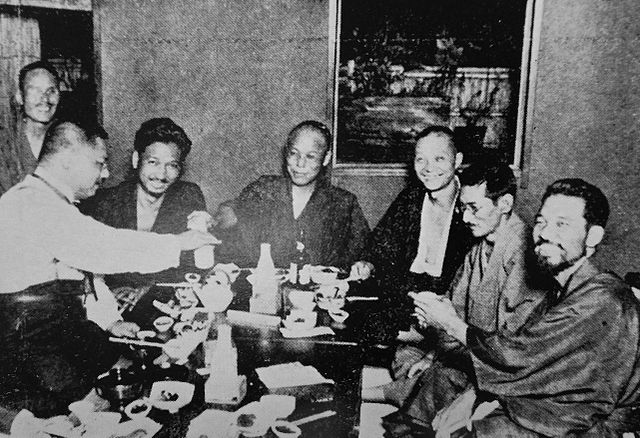
| Members of Baibunsha, one of the first translation agencies in Japan (1903). [Source] |
Prosperity and growing interest in world literature led to a translation boom from around 1907. By this time, even works from ‘minor’ countries were being translated, and there was growing criticism of relay translations. Alongside translations of Naturalist and Symbolist writers were translations of works by humanists, socialists, and nationalist writers. Japan’s increasingly conservative leaders viewed some of these as harming national unity, which led to growing censorship.
The Taishō years (1912-1926) were a time of high modernism, and translators experimented with heterogeneous language and different strategies, particularly in poetry. The aim lay in invigorating Japanese language, rather than a desire to respect the originals’ otherness.
In 1913 Iwano Hōmei translated Arthur Symons’ The Symbolist Movement in Literature. He favored preserving “the original word order or constituent order [e.g., theme–rheme] so as to recreate the logical and sensory flow” (Mizuno 2009). Although Hōmei wrote in literary Japanese, which remained prevalent until World War I, he believed new thinking demanded new modes of expression. The translation was idiosyncratic—perhaps explaining its impact on the younger generation.
Although domestication remained common, some translators, in the name of enriching the Japanese language, advocated foreignizing as a way to break out of the dead end facing the movement to align speech and writing, which had become stereotyped. In his 1913 translation of Salammbō, Ikuta Chōkō used translationese, making no attempt to convey Flaubert’s style. His Sinitic-like style contrasted with the flexible beauty of that of translators influenced by Ueda Bin. Although readers were not yet prepared for Ikuta’s foreignizing style, his translations were widely read, and some helped create Modernist literature.
In line with world literary trends, around 1910 tastes shifted from British and American works to European works, particularly Russian and French ones. World War I signaled a reverse shift to English works, along with increased interest in German works. Loanwords replaced kanji-based words as the standard approach to imported concepts.
The Russian Revolution accelerated the translation of key Marxist works in the early 1920s. Japanese were questioning their values in the wake of World War I, growing social unrest, and the 1923 Tokyo earthquake, contributing to the influx of revolutionary literature and socialist literary theory. Translations of leftist literature focused on the content rather than aesthetics, and the translators showed little awareness of the politics of translation itself.
Horiguchi Daigaku, whose stay in various countries between 1911 and 1925 enabled him to look at the Japanese language from a distance, adopted a foreignizing approach. The freshness of language and figures of speech in his Gekka no ichigun anthology (1925) had a major impact on later poetry and the Modernist movement.
One trend between the earthquake and Japan’s defeat in World War II was works of stream-of-consciousness, New Objectivity, and so on. “The new additions to the body of translated literature reflected a strong interest in contemporary, Western, literary currents such as Expressionism, Surrealism, Dadaism, Psychologism, and especially Proletarianism” (Von Schwerin-High 2004: 38).
The 1920s witnessed a ‘China boom’. Dissatisfied with kundoku and written-out versions in fixed verse form, which could not fully convey the meaning and wording of poetry, Satō Haruo attempted free translations in Shajinshū (1929). Free verse—a form that had not previously existed in Japan—was the domain of translated Western poetry, but Satō’s experiment (although not the first) helped scholars realize that perhaps Chinese poetry should be translated rather than understood via kundoku.
The role of paperbacks published by Iwanami Shoten, a leader in serious publishing, was particularly significant after 1927. Translations chosen for its Western Classics Paperbacks series effectively received recognition as a classic. However, Iwanami paperbacks were frequently translated by professors who were not skilled translators, so they often contained mistranslations and are in unreadable Japanese.
These years witnessed economic woes, political corruption, the apparent failure of the fragile democracy, and the growing influence of militarists. In 1927 the sheer volume of publications put an end to prepublication consultations with the Police Bureau. With the end of the ‘one-yen books’ boom around 1930-1931, the upsurge in translated literature came to a close.
In the 1920s there were few translations of French literature, mostly unreliable renditions via English. From the 1930s, however, many important French writers were translated. Growing US influence led to an awareness of American literature as distinct from British literature. Nevertheless, literati regarded it as “rather coarse and vulgar” and preferred English and European literature, which seemed “more easily adaptable to the traditionally refined Japanese expression and sentiment” (Kamei 1997: 74).
Nishiwaki Junzaburō’s Ambarvalia (1933) combined original writing and translation of European poems to produce a poetic language that foreignized Japanese and influenced later poets. The fact that Nishiwaki self-translated poems he wrote in foreign languages produced “not only a certain oddness, but a distancing or decontextualizing effect” (Selland 1999: 12).
Between 1910 and 1945 Japan colonized Korea. Although Korea's cultural products were held in low regard, some folksongs, classical novels, and contemporary works were translated in an effort to understand Korean culture, facilitate trade, and contribute to colonial management.
The 1931 Manchurian Incident and the February 26 Incident of 1936 prompted strict censorship of translated leftist literature. Given the increasingly right-wing climate, Soviet literature was subjected to careful scrutiny, and the number of Russian translations declined to almost zero by the end of World War II.
However, the Marco Polo Bridge Incident of 1937 and the Second Sino-Japanese War increased interest in China and its contemporary texts to some extent. Interest in Korea also rose during this war. Translators were mostly Korean nationals seeking to inform the Japanese about Korean culture.
Nogami Toyoichirō’s 1932 book titled Hon’yakuron discussed two approaches to translation, broadly equated with domestication (e.g., Tsubouchi Shōyō, Futabatei Shimei, Mori Ōgai) and foreignization (common among later translators). Nogami proposed a hybrid approach that remained faithful to authors but took readers into account. He also advocated ‘achromatic’ translation, achieved through word-for-word and phrase-for-phrase renditions. Although Nogami regarded reproducing the original tone and style as ideal, when that is not possible he believed it best not to impose one’s own tone and style. A revised version was published in 1938 as Hon’yakuron: Hon’yaku no riron to jissai. Here Nogami valorized a foreignizing approach where originals are allowed to shine through, even if this entails unnatural language, without translators adding personal or domesticating ‘color’. Nogami’s views generally met with favor, reinforcing the existing norm of fidelity.
Around 1933 and 1934 the repeated publication in the influential Eigo seinen periodical of views supporting faithful translation bolstered the dominant norm, as did views of translation as a research tool for accurate understanding (Satō 2008: 72). Repeated comments on mistranslations reflected researchers’ lack of trust in translation. Yet it became impossible to conceive of translation solely in terms of fidelity, accuracy, and an absence of mistranslations, because this had made translations difficult to understand (Satō 2008: 73). The introduction of British literary criticism contributed to a new emphasis on interpretation and the artistic nature of literary texts (Satō 2008: 95). Around 1935 the old and new norms coexisted, but by 1941 views stressing the artistic and creative nature of translation held greater sway.
The Pacific War halted interest in the writing of America and its allies. Many foreign literary works were banned. To some degree, literature from Japan’s ally Germany filled the gap, although this interest largely evaporated after Japan’s defeat. Wartime translations were subject to prepublication vetting, and paper for civilian use was rationed. During the war, translators and interpreters played important roles, while the Allied forces distributed translations of English-language propaganda to undermine Japanese morale. Japan occupied Vietnam until 1945, leading to some interest in French Indochina and translations on matters such as colonial and economic policies there. There were relay translations via French (the language of the previous colonial power) and translations of Vietnamese-authored works written in French, but virtually none from Vietnamese.
Early Occupation years (1945-48)
During the Occupation the Allies held a series of war crimes trials, involving over 200 translators and 50,000 pages of translated documents. Many translators were Japanese nationals, mostly academics and students, but American Nisei also played an important role.
One key initiative was a more democratic Constitution. Ostensibly prepared by Japanese authorities, it was based on an English document drawn up by the Allies’ General Headquarters (GHQ), with the two versions created in tandem. The power resided with Occupation authorities, but the Japanese had ways to circumvent some of the proposed content and language.
After the war there was pent-up demand for reading matter and information about democracy and the United States. For their part, Occupation authorities ‘weaponized’ translations to reorient the Japanese away from militaristic thinking and any potential shift toward communism.
In October 1945 a system of prepublication censorship was instituted. Books that were banned or obstructed included works that criticized Occupation policies, exposed the United States, introduced Communist ideology, or praised the Japanese military. In December 1946 GHQ allowed imports of foreign materials not detrimental to Occupation aims, opening the way for acquiring translation rights through an approval system.
From November 1945 to April 1948, 1,367 GHQ-licensed new translations were produced, but very few American works. Copyright on American books was valid for 28 years, with a further 28 years if re-registered, which hindered translation. US copyright fees were higher than in many other countries, and American publishers were slow to cultivate the Japanese market.
Restrictions were gradually eased, and formal censorship ended in October 1949, on the grounds that Japan was sufficiently democratic.
GHQ translation program (1948-51)
In May 1948 GHQ revised its licensing program by providing a list of 100 American and British works for auction that fell under international copyright law. Selection was based on what would steer Japan toward democracy, rather than literary or entertainment value. Publishers could not conclude translation contracts unless they bid for these works or went through an intermediary from an Allied nation. Successful bidders received priority in paper rationing. Bidding was highly competitive, and the resulting exorbitant authors’ royalties forced translators’ royalties down. With each round (13 from June 1948), the anti-Soviet tendency became more pronounced. Because GHQ-approved foreign copyright agents had begun to be active, the number of bidders declined, as did royalty rates.
As an alternative, foreign rights owners could apply to GHQ for “a no-fee blanket license to deal directly with Japanese publishers regarding any and all titles on which it controlled rights” (Hench 2010: 246). Most major US and several British publishers received blanket licenses. GHQ “continued to censor books under this plan, so having a blanket license was no guarantee of publication” (Hench 2010: 246). The number of agents gradually grew, so by the time the bidding system was abandoned in June 1951 it was no longer difficult to obtain translation rights.
Leftists were initially encouraged as a counterbalance to former rightists, and the Soviet Union was on the list of Allied powers not to be criticized. It had not acceded to the Berne Convention and had no bilateral agreement with Japan, so translations of Soviet works did not need permission. As the Cold War intensified from 1949, however, Occupation authorities allowed publication of material critical of the Soviet Union, in an attempt to exclude its influence, and later on they banned Soviet (and Chinese) contemporary literature.
Anti-war works were popular, as were wartime memoirs and existentialist works. In 1950 anti-American sentiment arose (related to the Peace Treaty, the Korean War, and problems with American bases), and publishing trends reflected this. Public interest in Russia was partly a reaction to American influence, while intellectuals were interested in Soviet culture and pre-Revolutionary Russian literature. Admiration for the establishment of the People’s Republic helped renew interest in China, through works of resistance literature, works dealing with China’s reconstruction, and modern literature. Nevertheless, translations of Chinese literature were scant compared with translations of Western literature. Although quite a few “people’s writers” were translated in the early 1950s, most were forgotten once the boom passed, partly because of careless text selection and poor translation quality.
Another early postwar trend was the translation of literary works with explicit sexual descriptions, perhaps representing an escape from the sense of defeat. In 1950 Itō Sei produced a controversial unabridged rendition of Lady Chatterley’s Lover. Itō suggested that the rationale for domestication no longer held and that translations, particularly of non-literary works, should move toward literal renditions—and that readers sometimes even preferred these because of a perception of greater accuracy, even if the translation was a little difficult to follow.
 |
| Muraoka Hanako (1893–1968). [Source] |
Around 1950, the publishing industry began to translate juvenile books with “positive, imaginative, and peaceful themes and messages” (Ochi 2006: 360), as well as fantasy and adventure books. The lack of texts in the domestic fiction genre and texts with female protagonists was partially filled by Muraoka Hanako’s 1952 translation of Anne of Green Gables. Many translations of books linked to movies began to appear, and this is now a small but important area of translation, as is subtitling.
By around 1950 the translations that won most readers were collected or selected works of world-renowned literary figures (into the first half of the 1960s), controversial paperbacks, and works of cultural or literary significance.
On GHQ instructions, in 1950 the education ministry issued a notice stating that copyright was not considered extinguished until 50 years after an author’s death, even though the Copyright Act stipulated 30 years. This aimed at imposing a uniform regulation on all Allied nations. Consequently, translations that could previously be published could no longer be published without obtaining translation rights. Payment of copyright fees involved additional costs and was difficult because of currency restrictions. It became impossible to conclude new contracts or continue existing contracts for foreign copyright.
When the Peace Treaty came into force on 28 April 1952, translations could appear without censorship, and the ten-year provision was revived. Nevertheless, in the years immediately prior to 1955 publishers often faced financial difficulties, and many translations went out of print.
Commercialization and self-cultivation (1960s-70s)
Economic recovery boosted translation as a commercial-professional activity. A massive number of technical texts, such as manuals, were translated. From around 1960 the scholar-translators and writer-translators of earlier years were slowly (not entirely) replaced by professionals. In literature, there was increasing emphasis on entertainment. It was not until the late 1960s that female American writers were translated, along with other minorities (e.g., American-Jewish writers). Latin American literature began to attract attention, with an improvement in the quantity and quality of translations from the end of the fifties into the mid-sixties. The boom in French literature continued from the latter sixties into the early seventies. From the 1950s to the 1970s, Takeuchi Yoshimi translated all the major works of celebrated writer Lu Xun.
Behind the boom in anthologies lay increased wealth and a desire for self-cultivation. Since most world classics had already been translated, however, these lacked the impact of prewar anthologies. The tradition of self-cultivation began to collapse, and from the 1970s fewer readers purchased multivolume collections, although the first half of the 1970s witnessed translations of the complete works of certain writers.
International events affected translations. For instance, the 1960 revision of the US–Japan Security Treaty, the establishment of diplomatic relations with South Korea (1965), and the Vietnam War all led to an increase in translations. The 1971 abolition of the 10-year copyright provision led to a downturn in translations, although it likely boosted translations of works whose copyright had expired.
A more theoretical interest in translation emerged with the April 1973 appearance of the academically inclined journal Kikan Hon’yaku, although it ended in June 1975 and had limited readership. Furuno (2004) found that attitudes toward translation underwent a change from adequacy to acceptability in the mid-1970s (an increased focus on readers). She relates this to the popularization of translations and emergence of professional translators. Other possible factors include the communicative emphasis in translations for information (the bulk of translations) and Japan’s growing cultural confidence. Importantly, Mizuno (2009: 46) postulates that “the translational norm of modern Japan has been the coexistence of competing norms”.
Celebrity translators (1980s-...)
Except for ‘general’ works and the arts, the share of translations in nearly all fields declined in the seventies and eighties, but a boom in translated literature occurred in the 1980s, partly related to the appearance of author-translator Murakami Haruki. Murakami translates books he wishes to introduce to readers or from which he can learn (e.g., style, word choice). His translations are characterized by stylistic fidelity and readability. Murakami’s name value has contributed to the popularity of contemporary American literature.
Most translations in the early eighties were of literature (e.g., science fiction) and social sciences, followed by books for young readers. The Seoul Olympics sparked interest in contemporary Korean literature. Women translators represented a strong presence, particularly in relation to translated romances.
In the early nineties the Americanization of translation continued, partly because of American literature’s marketing power, but many new series focusing on unfamiliar minority literatures also appeared. The Harry Potter series prompted a boom in fantasy-style novels, original and translated.
The translator Shibata Motoyuki came to the fore as a University of Tokyo professor and editor for Murakami Haruki’s translations. Together they have done much to popularize contemporary American literature. Shibata has not adopted a highly theoretical attitude, preferring to simply translate so that it feels right. He believes translators’ loyalty lies with the text and readers, and he does not try to use different styles for different authors or impart his own voice. By producing literal-sounding texts he strives to allow the English to be apparent. His priority on reproducing the rhythm often requires following the original word order (within Japanese grammatical constraints). Shibata recognizes that this means a natural source text becomes unnatural, but the expression is crisper and a different impact is produced.
Yanase Naoki was noted for the challenging works he chose and his inventive use of Japanese. His most famous translation was of Finnegans Wake. Although parts of this had earlier been translated, Yanase’s rendition was the first complete and single-handed Japanese translation. The first volume appeared in 1991 and the second in 1993. To reproduce or compensate for Joyce’s word play, Yanase drew on the Japanese language’s homophonic potential, aided by the kanji conversion possibilities of Japanese software. Challenging readers, he relied not on katakana but kanji, which express sound and meaning. Yanase also translated Ulysses. The translation is regarded as outstanding, conveying the multiple layers of sound and meaning in Joyce’s language.
Quite a large number of Korean works were translated in the 1990s, covering a much broader spectrum than in the past. Interest focused on Korean politics or banned books about sex. When China acceded to the Berne Convention in 1992 it became necessary to obtain permission for translation and pay royalties, which affected translations.
The 9/11 terrorist attacks in the USA led to a spate of translations of books related to Islam, Afghanistan, terrorism, and biochemical warfare. Best-selling translations in the aughties included business- and success-oriented books with a reader-friendly story form, filling a gap in Japanese book offerings. The success of Ikezawa Natsuki’s Sekai bungaku zenshū (from 2007) prompted new interest in literature anthologies.
Japan has long published many new translations of previously translated works, but recent decades have witnessed a retranslation boom. The new versions have helped dispel the image of foreign classics as old-fashioned and difficult, curbed younger readers’ move away from translations, and provided existing readers with new perspectives. Although Murakami Haruki praised Nozaki Takashi’s 1964 translation of The Catcher in the Rye, he believes it desirable to have multiple translations of masterpieces to suit the needs of the time, so he translated this in 2003. Murakami believes works translated during the 1960s boom have reached their “use-by” dates because of changing writing styles in Japanese. In 2006 he retranslated The Great Gatsby because earlier renditions did not represent his image of this novel.




Kanbun kundoku, the non-conventional mode of “translation” adopted in premodern Japan, has counterparts (with variations) in other parts of East Asia, such as in the Korean, Old Uighur, Khitan, and Vietnamese languages. Analogs also existed in the form of partial or total alloglottography in the ancient Near East, as well as in the form of vernacular glosses on some Latin texts in medieval Europe. There is room for further research into these practices that enabled the conveying of meaning across different languages using modes that do not conform to contemporary (Western) conceptualizations of translation. This has the potential to broaden and deepen our understanding of translational practices not only in Translation Studies but also in the fields of Asian Studies, Ancient Near East Studies, and Medieval Latin Studies.
The study of the professionalization and institutionalization of translation in Japan is relevant to sociological approaches to Translation Studies, while the description of the different roles played by translation in Japan is relevant to the study of Japanese history and Japanese literature.
In particular, there is much room for further research on translation in the twenty-first century, where the timeframe makes it more challenging to identify trends and patterns.