 |
 |
 |
 |
 |
 |
 |
ARA النشاطية FRA Activisme SPA Activismo |
contents
Introduction | Decolonization and race | Feminism and gender | Social movements and solidarity networks | New media and digital activism | Research potential
**

For much of its history, the theory and the practice of translation and interpreting have been influenced by the principles of neutrality and faithfulness to the original message and by a pejorative view of translators' personal, ideological, or cultural engagement as a bias. Several schools of thought in translation studies have challenged this paradigm and accounted for the agency of translators and interpreters to intervene and (re)construct meaning. Activist translation may well constitute the most radical challenge posed to neutrality, as it not only brings to the fore the positionality of translators and interpreters as well as the political agendas of translation and interpreting. It also advocates for a deliberate, intervenient practice capable of exposing, disrupting, resisting and transcending sociopolitical dominance and bringing about sociopolitical change.
In the footsteps of postcolonial and feminist approaches that reshaped the field in the 1990s, the activist approach in translation studies emerged in the 2000s with Baker’s seminal papers (Baker 2006, in particular) and with a number of foundational collective publications. These include a special issue of TTR on Translation and Social Activism (Simon 2005), the collected volume Translation, Resistance, Activism: Essays on the Role of Translators as Agents of Change (Tymoczko 2010), and the Spanish-English bilingual volume Compromiso social y Traducción/Interpretación – Translation/Interpreting and Social Activism (Boéri & Maier 2010). Articles in these publications address key ethical and political dimensions of translation in contexts of resisting censorship, cultural, economic and military domination, as well social, racial and gender inequalities and injustices.
In the second decade of the century, activism in translation consolidated as an important area of enquiry in the field, as attested to by the publication of dedicated entries in both the Routledge Encyclopedia of Interpreting Studies (Boéri 2015) and the Routledge Encyclopedia of Translation Studies (Boéri 2020), and by the publication of the Routledge Handbook of Translation and Activism (Gould & Tahmasebian 2020). The recent publication of a special issue on translation and social justice, guest-edited by Boéri (2024), where activism features prominently, shows that scholarly interest in this key area has not waned over the years in a world in permanent crisis.
Taken together, these publications map the evolving landscape of activism in translation by addressing a wide range of contexts (e.g., social movements, media networks, digital communities) and modalities (e.g., translation, interpreting, subtitling, dubbing). Against this backdrop, this entry provides an overview of activism in translation (studies), structured around interrelated thematic and sociopolitical clusters – decoloniality and race, feminism and gender, social movements and solidarity networks, new media and digital activism. In conclusion, it points to the emergence of translation as a transdisciplinary and intersectional paradigm for social justice, beyond the confines of translation studies.
Historically, translation has operated as an instrument of imperial domination and resistance, as well as a vehicle of discovery and emancipation. Under colonial rule, translation was a weapon to impose colonizing states’ epistemologies on indigenous knowledge systems and serve corporate and proselytist interests. For example, Korak's (2024) recent fieldwork in the Waorani territory in Ecuador argues that the controversial evangelical missionary organization Summer Institute of Linguistics (SIL), specializing in translating the Bible into indigenous languages, not only perpetrated an ethnocide in the 1960s (forced contact, forced settlement into a reserve and forced evangelization), but also allowed white settlers and oil companies to exploit and extract the resources of the land. After SIL’s expulsion from Ecuador in 1981 and the recognition of linguistic and cultural rights of the Waorani people in Ecuador’s revolutionary constitution in 2008, the Waorani people who still face multiple extractivist threats on their territory, have to a certain extent reappropriated translation and interpreting, which they assign to members of their own community (see Korak 2024).
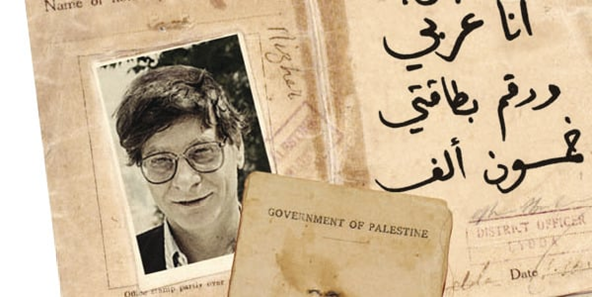 |
| One of Mahmoud Darwish's most famous poems is "Identity card". |
Despite the daunting power differential between colonizers and colonized, translators’ and interpreters’ role in resisting (neo)colonial agendas is well documented in the history of translation. To name but a few illustrative examples, Irish nationalists in the 19th century translated Gaelic literature to preserve cultural identity under British rule; African writers such as Ngũgĩ wa Thiong’o have advocated for translation into indigenous languages as part of a broader project of linguistic decolonization; Palestinian writer Mahmoud Darwish made creative uses of multimodal, interlinguistic and intersemiotic translation to resist the Israeli colonial narratives as well as hegemonic narratives of selves and others in Palestine, in his fight for justice for the Palestinian people (Alhirthani 2024).
As the colonial project persists in the 21st century, through economic and military domination of the Global North over the Global South, of the West over the East, through settler colonization and through extractivist projects against indigenous communities, the activist approach can cast light onto the theory and the practice of decolonizing knowledge. Indeed, while translation may perpetuate the epistemicide of colonialism and the imposition of hegemonic ways of knowing about nature, culture, science, and society, it can also constitute a decolonial tool (Price 2023). Activist translingual and transcultural practices informed by theories of decoloniality and translation have the potential to do “reparative translation” (Bandia 2024), understood both as an ethical practice of translation (p. 53) and a concept which “attempts to elaborate a framework for elucidating and redressing the inequities brought about by colonisation and slavery” (Bandia 2024: 52). A good illustration of such practices can be found among the communities of Argentine Patagonia who oppose fracking, the hydraulic fracturing of rocks to extract non-conventional fossil fuels with detrimental environmental, health and cultural consequences (Piñeiro 2025). Piñeiro’s fieldwork reveals that as soon as the word started to spread regarding the introduction of fracking in the region, the Mapuche community, and later non-indigenous communities and NGOs, worked towards accessing and sharing strategic information (at the time mostly available in English), which involved translation, interpreting and multiple forms of mediation and contextualization. The legacy of the genocide of the Mapuche people, the displacement of survivors to these unproductive rocky lands, and the new gold mine that they now constitute in the eye of transnational corporations and states, remind us that racialized communities are the most affected by the imposition of technico-scientific progress by profit-making and extractivist agendas.
Race is a central prism to critically engage with contemporary colonialism. It compels translation studies scholars and practitioners to reflect on the lived experience of racialization, slavery and colonialism, and how it brings purpose to the practice of translation. The Amanda Gorman translation controversy, for example, made visible that the demographic and ideological dominance of whiteness continues to shape assumptions about who is qualified to translate whom, with calls for racial “matching” derided by some as “identity politics” while masking a long-standing racial gatekeeping within the field (Tachtiris 2024). Rather than asking whether only Black translators can translate Black authors, the more urgent question becomes: how do norms of whiteness define literary merit and translator authority in the first place? And how the experiences of (anti-)racist politics lived by translators of color, rather than essentialized identity, may bring to bear on their practice of translation (Tachtiris 2024)? In this light, activist translation today must not sideline race. As Tachtiris (2024) argues, it must grapple with the ways in which race functions in texts and institutions alike, and that translating racism (lexically, structurally, and ideologically), requires a shift from idealized notions of universality and white supremacist norms toward more situated, coalitional approaches grounded in accountability and structural change.
The question of race is cornerstone in the language justice movement that took shape in the USA at the end of the 1990s and within which translation and interpreting workers’ cooperatives have flourished (see the section on “Social movements and solidarity networks”). It has also become central to the critique of AI-generated translation in the academic publishing industry, as it enslaves a racialized and gendered labour in the global south, it compounds the climate crisis and perpetuates biases of all sorts (see Boéri & Baker 2025).
 |
| A side-by-side of a vintage Hardee’s ad and Eli Rezkallah’s reimagined version from their series “In a Parallel Universe” [Source] |
Emerging in Canada in the 1980s and 1990s (most notably through the pioneering work of Barbara Godard, Luise von Flotow, and Sherry Simon), feminist translation initially focused its critique on androcentric language norms to expose the historical erasure of women’s voices, and to advocate for amplifying women’s perspectives in the translation/rewriting process. Feminist practices of translation share a commitment to resist linguistic erasure and assert alternative modes of authorship through textual interventions and transformations, including:
a. rewriting gendered phrases to debunk and subvert patriarchal or heteronormative norms;
b. amplifying female authorship by making explicit or non-explicit references in contexts where they were previously erased;
c. using paratextual strategies, such as footnotes and prefaces, to expose gender bias in the original text and contextualize translation choices.
Activist practices towards gender justice extend beyond literary translation. In the context of advertising, for example, Gardabbou (2021) explores parody ads as a genre for feminist translators to disrupt women’s structural exclusion from decision-making in commercial media industries and the subsequent patriarchal and racialized discourses that are embedded in global consumer culture. Through close analysis of counter-campaigns, such as the backlash to BIC company’s reductive Women’s Day slogan (“Look like a girl. Act like a lady. Think like a man. Work like a boss”) and Eli Rezkallah’s “In a Parallel Universe” series, Gardabbou shows that parody ads function as a space of feminist resistance that is far from monolithic and operates within multiple sociocultural and ideological frameworks.
Feminist textual interventions have consequences on the theory of translation and, more specifically, on the role traditionally allocated to translators. From the outset, feminist translation disrupted the gendered devaluation of translation as a subaltern, feminine, and derivative activity, in contrast with the presumed authority of male authorship. Embracing this critique not only takes translation beyond its masculinist and binary conceptualization but also expands the boundaries of the practice which is no longer limited to the constraints of the original text. For instance, in her Arabic translation of Nathaniel Hawthorne’s The Birth-Mark, Gardabbou (2018) provides a "transcreation" which functions simultaneously as a feminist intervention into the text (e.g., by manipulating the title, rewriting the ending, inserting a feminist translator’s preface and illustrations, embedding a story within a story, and Arabizing names and references) and a meta-reflection on the positionality of both women characters in the story and feminist translators of that story. As the extradiegetic translator, she embeds a translator-character within the narrative itself (through the use of the mise en abyme technique). This procedure not only allows her to disrupt the conventional hierarchy between author and translator, but also to voice, through this translator in fabula, a feminist interpretation of The Birth-Mark and give it shape in the Arabic translation.
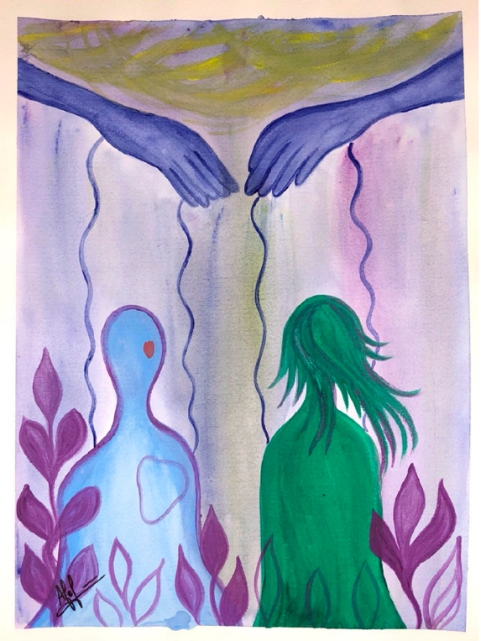 |
| Watercolor illustration “Woman and Translator Dominated by the Author” from Gardabbou’s Arabic transcreation of The Birth-Mark (Gardabbou 2018) |
Collective and community-driven translation endeavors have become vital to gender justice, breaking away from the individualistic, elitist and Western-centered foundations of feminist translation. Two cases in point are the project Qalat al-Rawiya: Gender-Sensitive Storytelling and Bosseaux's (2025) recent work A Voice of Their Own: Encouraging Caring and Ethical Practices in Trauma Screen Translation.
Initiated by The Women and Memory Forum (WMF) in Egypt, the project “Qalat al-Rawiya: Gender-Sensitive Storytelling” offers a model grounded in collaborative and collective practice to reengage with and transcend the androcentric legacy of a shared corpus of tales, specifically Egyptian colloquial folktales and classical stories from A Thousand and One Nights. Led by Hala Kamal, the project brought together women writers, scholars, and artists to collectively analyze these stories from a gender-sensitive perspective. The resulting texts include adaptations in Modern Standard Arabic and/or Egyptian vernacular, often accompanied by illustrations and reimagined through culturally specific devices such as oral storytelling and roundtable narration. These re-narrations foreground the voices of women through critical analysis and creative rewriting and reframing, offering alternative role models and disrupting patriarchal tropes embedded in traditional narratives.
Practice-based research constitutes a powerful tool in activist translation. This is well illustrated by Charlotte Bosseaux’s and Ling Lee’s multilingual documentary Surviving Translation, of women asylum seekers’ lived experiences of gender-based violence during their journey to the UK and upon arrival. In this collaborative work, with survivors of violence at the center, the collective practice of documenting, subtitling and voiceover the lived experience of sexual violence and coercion informs and is informed by a reflection on the emotional and ethical stakes of producing and circulating trauma narratives in translation (Bosseaux 2025). Indeed, Bosseaux shifts the focus away from technical fluency towards “filming and translating ethically,” “making sure survivors’ voices are truly heard,” and “convey[ing] fully the emotional content” of their testimonies (Bosseaux 2025: 3), as she strives to preserve survivors’ voices and narrative agency while avoiding retraumatization and distortion.
Over the years, gender justice has come to encompass the rights of all sexual minorities, including not only women but also LGBTQI+. For example, the Turkish translator of Alice Oseman’s queer graphic novel Heartstopper, Ömer Anlatan, employs multimodal interventions that include the use of LGBTQI+ activist terminology and the deliberate retention of derogatory terms to expose homophobic discourse in Türkiye (Alan 2024). Alan’s detailed study highlights how crucial the support of the publisher (Yabancı Publishing) was to confront Türkiye’s censorship and advance gender justice. Institutional, political and cultural institutions of the country where activist translators operate shape their practices. This is so even in the most digitalized contexts. For instance, Song’s (2024) study of the Wanwan fansubbing lesbian community in China illustrates how fansubbers champion gender justice within the specific constraints of China han-xu politics. Han refers to the active and overt suppression of queer visibility through censorship and bans and xu, to the less confrontational systemic withholding and marginalization of queer identities. Faced with this twofold state strategy, this community adopts a non-confrontational activist approach, which subtly integrates queer narratives into the audiovisual material and, more expansively (albeit cautiously), through reflexive digital paratexts such as social media posts, visual design, and community commentary, where there is a slightly greater freedom to create content that evokes reflection on queer topics.
This overview underlines that translation functions as a tool for transnational dialogue, resistance, solidarity, and activism for gender justice. Castro & Ergun (2017), in particular, reposition feminist translation as a politically committed, intersectional praxis that cuts across struggles and challenges the hegemony of Western, patriarchal and heteronormative knowledge systems. They argue for a decentered, transnational feminist translation that foregrounds the voices and experiences of marginalized groups, engaging with decolonial, queer, and Global South perspectives, and creating spaces for solidarity and resistance across linguistic, cultural, and geopolitical divides.
![[heading title]](2.2-X.png "[heading title]") Social movements and solidarity networks
Social movements and solidarity networks
Activist translation and interpreting have featured prominently in transnational social movements and solidarity networks, particularly in the alter-globalization movement or the global justice movement. Encompassing multiple struggles including environment, peace, justice, and democracy, where gender, race, class and ability intersect, the global justice movement functions as an umbrella term for the convergence of multiple and interconnected social movements from across the globe that challenge the imposition of a capitalist, war-mongering, and authoritarian world order. Given its transnational, intercultural and multilingual nature, the global justice movement is contingent upon multiple forms of translation. It has thus constituted a fertile ground to study activist communities of translators and interpreters and to theorize activism and solidarity in the field.
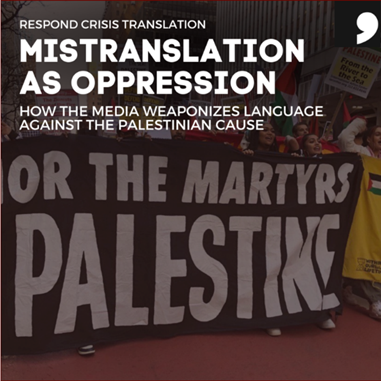 |
| From Comma Press blog article discussing BBC’s mistranslations of Palestinian voices [Source] |
Within this movement, activist collectives such as ECOS, the Association of translators and interpreters for solidarity, and Babels, the international network of volunteer translators and interpreters, emerged in the 1990s and the early 2000s, respectively. They not only volunteered for the movement but also contributed to a turnaround in translation studies, and particularly in interpreting studies, which had developed independently of translation studies and whose theories and schools of thoughts were mostly market-oriented at the time (see Boéri & De Manuel 2011). Babels, for instance, departed from the service provision mindset (Boéri 2008) and embraced the principles of horizontality, participation, deliberation, and decentralization, to ‘prefigure’ an alternative way of organizing interpreting, of training volunteers, and an alternative digital space of consensus decision making (Boéri 2012; 2023a; 2023b). These collectives inspired activists and scholars to critically engage with the corporate logics that presides over the translation industry, profession, and curriculum. For instance, in the international forum on translation/interpreting and activism organized by ECOS in Granada (Spain) in 2007, practitioners, teachers, and scholars, issued a declaration to call for expanding the field of translation and interpreting, their practice, related professions, theories and pedagogies beyond mainstream society and for repositioning it in opposition to the devastating effects of wars of occupation and neoliberal policies (Granada Declaration 2010). More recent collectives include Guerrilla Translation, as part of Guerrilla Media Collective, Respond Crisis Translation, and other cooperatives of language justice that have flourished in the USA and, to a certain extent, in Latin America.
The most detailed account of how activist interpreters may intervene in cross-language encounters to date, is Doerr's (2018) empirical study of various deliberative spaces connected to the social forums and the global justice movement, including the language justice movement. Although the data is not focused on interlinguistic translation per se, she finds that interpreters, mediators and organizers endorsed and practiced ‘intentionality’, i.e. acting upon racial, class, gender injustices that are reproduced in the communication encounter. Engaging with interpreters’ (and translators’) interventions in cross-language encounters requires not only access to data and linguistic skills, but also to emancipate our analysis from the deontological and liberal ethical frameworks that have prevailed in the field. In an attempt to fill this gap, Boéri (2023c) advances a meta-ethical approach and develops a tridimensional model by streamlining the insights from the practice, the organization and the theory of activist interpreting, including Babels and the language justice movement. The model she proposes accounts for interpreters’ interventions in the communication encounters (micro level), while taking into account how the politics of organization (macro-level), and the theories and epistemologies of interpreting (meso-level), may constrain, enable and shape such interventions. By identifying both the challenges and the levers of social justice in the practice, organization and theorization of interpreting, the model can contribute to steering interpreting ethics towards social justice.
Activist audiovisual translation also features prominently in social movements and uprisings, particularly with the rise of new media and collaborative digital platforms. Translation collectives have increasingly used subtitling to produce, mediate and circulate their experience of revolution across the world. During the Egyptian uprisings, for instance, translation collectives such as the Mosireen video collective and Words of Women from the Egyptian Revolution played a crucial role in mediating protest discourses, bypassing censorship, and circulating testimonies across linguistic and national boundaries (Baker 2016). Because audiovisual translation is often weaponized by mainstream media in contexts of violence, it comes under the scrutiny of activist collectives. For instance, in the context of the ongoing genocide against the Palestinian people, Respond Crisis Translation exposed BBC’s mistranslations of Palestinian voices, and the subsequent public outcry forced the BBC to retract (Comma Press 2023).
The study of activist translation across modalities has yielded important theoretical insights into the practice and the theory of solidarity in a world whose concentration of resources, authoritarianism, racial and gender violence have worsened at incredible speed since the turn of the century. Prefigurative politics, the principle of embodying and enacting the change one wants to see, has been central to theorizations of activist translation and interpreting (see Boéri 2012; 2023b; Taviano 2016; Baker 2013), although it has cast more light onto the organization rather than the actual performance of translation and interpreting (Baker 2020; Boéri & Delgado Luchner 2021). More recently, however, Baker (2020) questioned the capacity of prefiguration to equip activist translators and scholars to provide appropriate solidarity support to the most disenfranchised. She argues that the level of trauma and destruction they face inhibits their ability to envisage a better future, which is at the core of prefigurative politics. She advances ‘aspirational translation’ instead, a semiotic strategy that draws on the limited resources at hand in the present and on the untapped resources of the past and the recent past, for people to heal, make sense of and reappropriate their living spaces. In response, Boéri (2026) draws on aspiration and prefiguration to revisit activist translation in the global justice movement. Her genealogical account highlights that while the anarchist prefigurative praxis of horizontality initially diverged from aspiration, the more recent decolonial and feminist prefigurative praxis of intentionality converges with aspiration. Boéri concludes that reconciling prefigurative and aspirational translation is not only possible but also politically necessary to weave networks of solidarity.
New media and digital activism
While acts of political resistance and activism have certainly been a reality in translation through centuries, the activist approach in translation and interpreting studies is only two decades old. In this span of time, translation and interpreting have been transformed and increasingly disrupted by information and communication technologies to the point that fully automatized translation and interpreting, often relegated to a hypothetical, even unlikely future, are now becoming a reality. Against this backdrop, activist translators’ use of technologies is highly ambivalent.
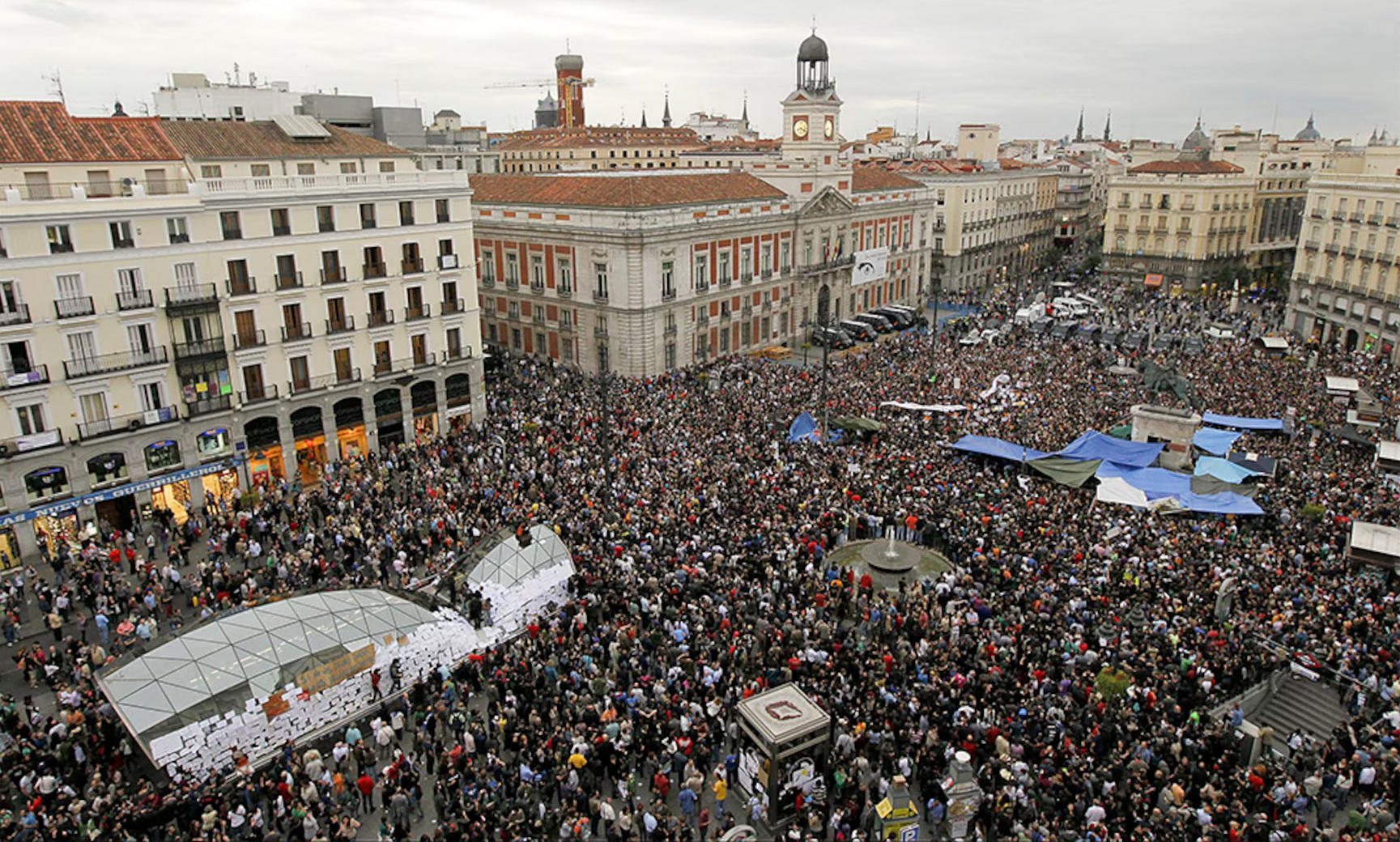 |
| 15M protest, 20-21 May 2011 at Puerta del Sol, Madrid (downtown). [Source] |
The participatory web (also referred to as web 2.0) at the end of the 1990s and the early 2000s has ushered the development of new organizational forms that challenged the usual market-oriented modus operandi of professional organizations. For instance, Babels’ use of the electronic tools yielded by web 2.0 not only allowed the network to embrace participatory and deliberative modes of decision-making, but also to challenge traditional modes of organization, based on expertise, hierarchy and economic interests, as evidenced in the controversy that opposed it to AIIC, the international association of conference interpreters (see Boéri 2023a). Similarly, the use of collaborative platforms to dub, subtitle and translate across media, allowed activists to come together temporally in order to respond to a political urgency and champion a given cause and then disperse; what Pérez (2010) refers to as ad-hocracies.
Artists involved in resistance movements resort to global streaming platforms as a common political strategy to explore the interplay between language, culture and identity (Taviano 2016). Similarly, activists are now increasingly using fan fiction platforms to creatively rewrite mainstream narratives and subvert hegemonic cultural representations; a political and aesthetic process of collective and digital rewriting that Farley (2016) frames as translational.
Social media in the second decade of this century have become central for activists to report on political resistance and protests, from the Egyptian revolution to the Spanish 15M political movement, in an increasingly fragmented information landscape (Sadler 2021). But technologies alone do not suffice to amplify the voices of the oppressed. For instance, faced with the absence of international journalists in Gaza, citizens resort to translation to reach international audiences. However, as Gazan translator Alaa Alqaisi highlights, Palestinians are translating between “wounds and words”, between the lived experience of genocide and a global discourse shaped by euphemism and avoidance, which leads her to wonder: “The most painful question I ask myself is not whether I should translate, but whether anyone is listening”, particularly when the translation disrupts the very language structures that silence the Palestinian experience (Alqaisi 2025).
While citizen, participatory, activist translation practices tend to develop outside and in opposition to the translation and interpreting industry, the technologies they resort to are unavoidably embedded within the very discursive and physical structures of corporate and military oppression. Given the increased concentration of media technologies in the hands of the Big Tech, with limited public control over the use of the big data produced by citizens, the ethics and politics of translation technologies, particularly artificial intelligence, constitute a rising concern not only within solidarity economy activist translation circles (see The Guerrilla Media Collective Handbook), but also across the translation, interpreting, and publishing industries, as well as in higher education.

Over the last two decades, activist translation practices have been accounted for and theorized across modalities and contexts. As we have seen, activist (communities of) translators and interpreters may support and participate in various struggles (related to race, gender, class, culture, or particular citizenship status), resort to various genres (literature, films, documentaries, forums and other strategic gatherings, etc.), modalities (written, oral, audiovisual, etc.), organizational forms (ad hoc or formal, temporary or permanent) and interactions (face-to-face, online).
Future research can build on this knowledge, emerging from this multifaceted field of practice, by adopting an intersectional approach to solidarity and activism. This not only means paying attention to the multiple layers of discrimination and subjugation that bring to bear on people’s rights, but also to wage resistance and develop alternatives from that intersectional standpoint.
Relatedly, the multiple injustices that activist translators attempt to redress – colonialism, imperialism, extractivism, patriarchy, heteronormativity, and racialization – are all interconnected. Thus, the extractive economic and technological order we are living in cannot be defeated without the critical contribution of multiple disciplines to social justice. The attack on our very social and intercultural fabric, on our health and that of our planet demands the development of counter-hegemonic knowledge, not only in the humanities and social sciences but also in the so-called hard science. Within this transdisciplinary and counter-hegemonic drive, translation has a key role to play (Doerr 2018; Boéri 2024; Boéri & Baker 2025). The richness of methodologies and theories used in and inspired by activist research and research on activism equips scholars and practitioners to harness the transformative potential of translation to co-construct counter-hegemonic knowledge and contribute to change and justice.